Daily Weird News Report
Mars appears to have a deep internal divide that mirrors the dramatic contrast between its two hemispheres, according to a study reported by ScienceDaily from Caltech.
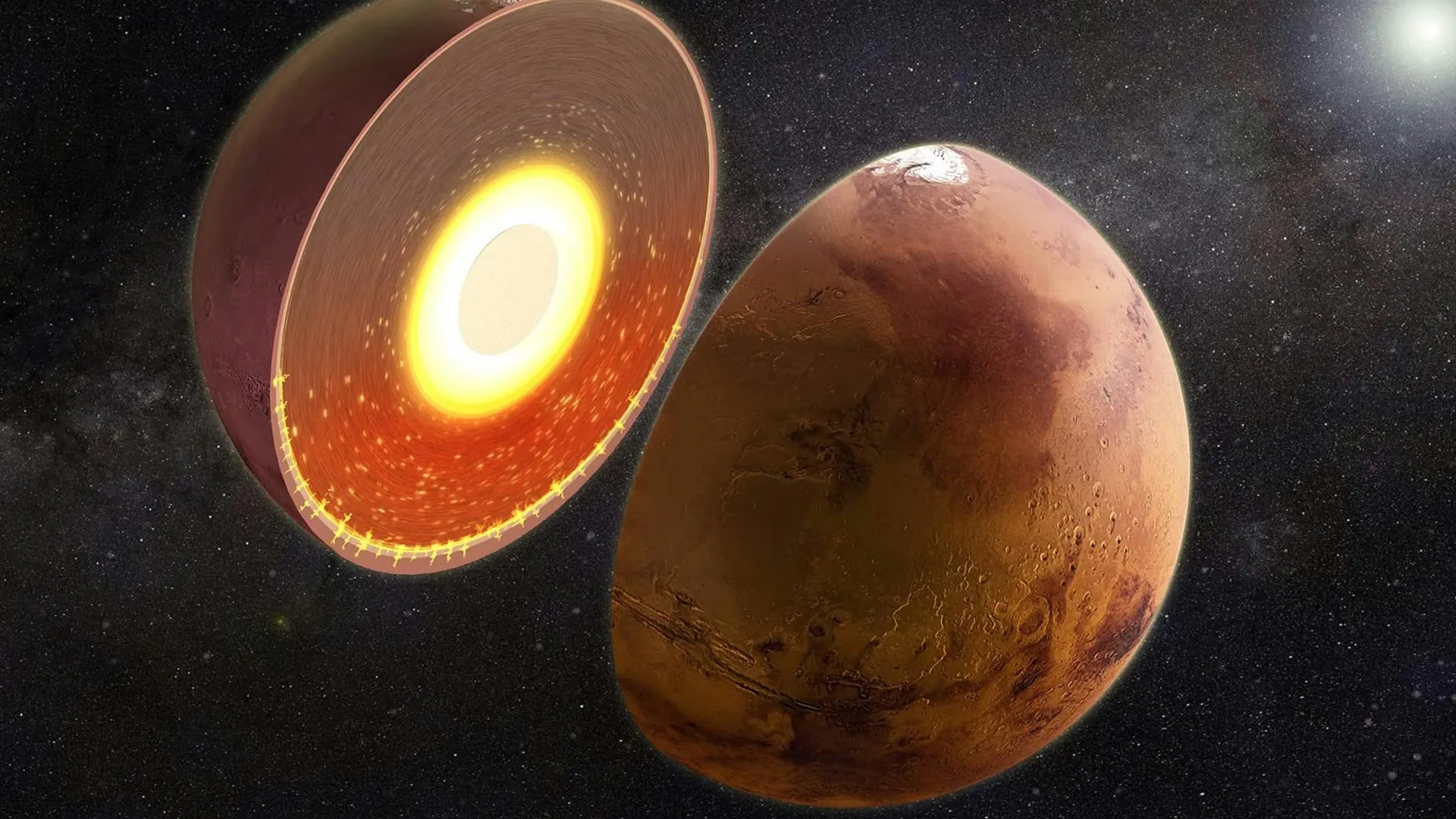
Researchers found that the interior beneath the planet’s southern hemisphere may be roughly 200 to 400 degrees Celsius warmer than the northern interior. The southern region may also be partially molten, although the study does not establish what created the temperature difference.
The team reached its conclusions by examining Mars’s gravity field. Researchers analyzed decades of observations from Mars Global Surveyor, Mars Odyssey and Mars Reconnaissance Orbiter, tracking tiny changes in spacecraft velocities. They then used a technique called tidal tomography to model how Mars’s interior responds to changing gravitational effects over the planet’s seasons.
The results extend a familiar surface-level distinction. Southern Mars is dominated by highlands and heavily cratered terrain, while the north is characterized largely by broad, low-lying plains. The study suggests that this north-south dichotomy continues deep below the crust.
The proposed thermal imbalance could help account for several observations. Iron-rich minerals in the southern hemisphere contain unusual magnetic signatures, and a hotter southern mantle could be connected to differences in magnetism between the two regions. Data from NASA’s InSight mission also showed that seismic waves lose energy more rapidly in the south; higher temperatures may help explain that pattern.
The internal temperature divide may also offer clues to Mars’s ancient hydrology. According to the researchers, understanding the difference could shed light on the formation of basins that may once have held water and on the planet’s evolution during periods when liquid water might have existed at the surface.
The cause remains unresolved. Possibilities discussed by the researchers include heat released by a massive impact in the north, past convection in the southern mantle, or thick southern geological structures that slowed the escape of heat.
The study, led by Alexander Berne, was published in Nature on August 27. It was funded by NASA.