Daily Weird News Report
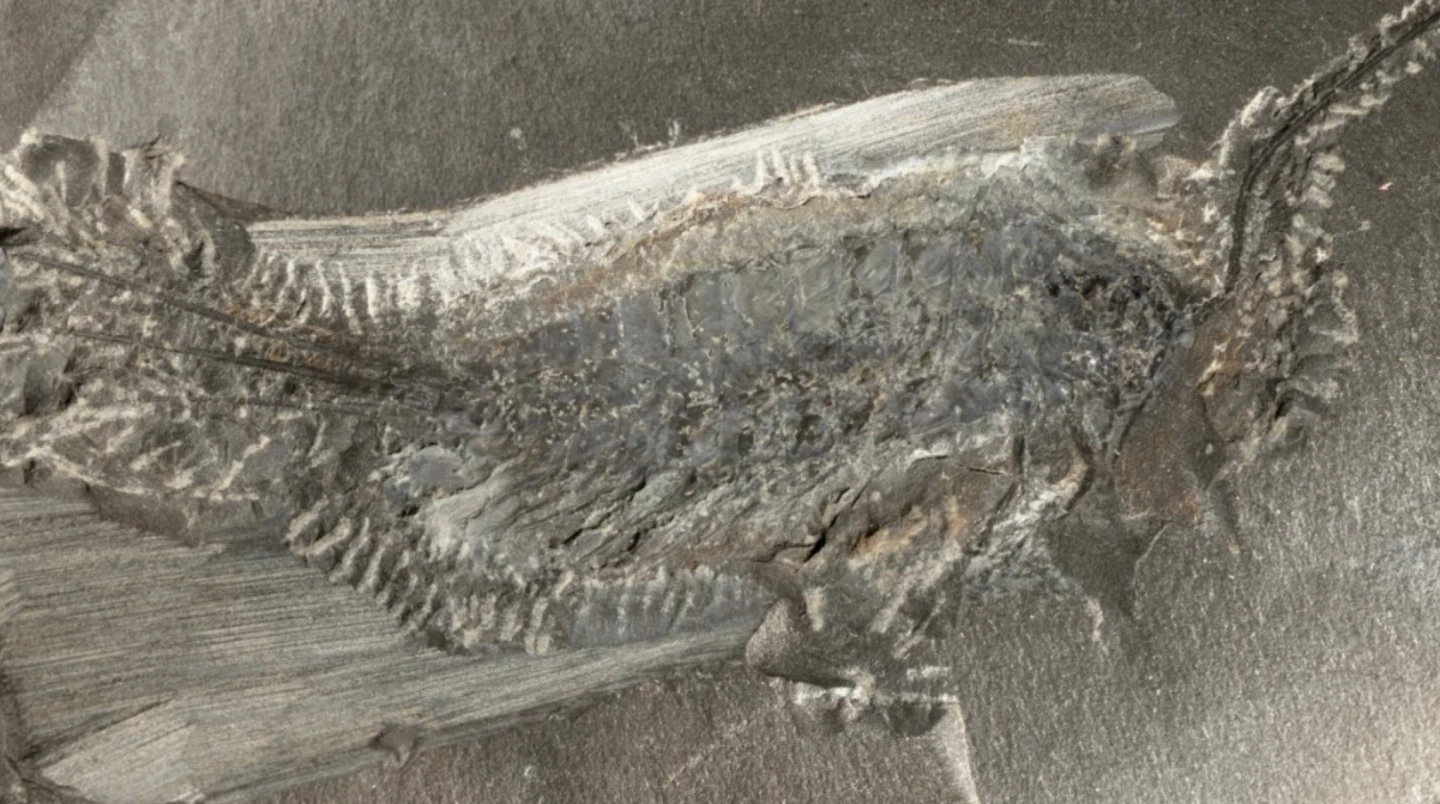
A fossilized animal that lived 324 million years ago appears to capture an unusual stage in the evolution of insects: part aquatic creature, part land-adapted animal.
The specimen, named Chosha praecursor, was discovered in Texas and had previously been classified as an ancient crustacean. Its segmented abdominal appendages seemed consistent with crustacean anatomy, while important insect features were overlooked.
In a new study, researchers from the Nanjing Institute of Geology and Palaeontology of the Chinese Academy of Sciences and colleagues in the United Kingdom, United States and Spain examined the fossil using cross-polarized light. The technique revealed three distinct thoracic segments and three pairs of legs—features associated with the basic body plan of modern insects.
The animal also had nine pairs of appendages along its abdomen. According to the research described by New Atlas, these structures were not conventional walking legs and appear to have been adapted for use in water. Together with its six insect-like legs, they gave the animal 24 limbs or limb-like appendages.
The fossil was found in an area that once lay where water and land met. Researchers therefore interpret it as evidence of an insect lineage adapting to life beyond the water, rather than as a fully terrestrial insect. The specimen appears to have been an adult female measuring about 3.2 centimeters long, or roughly 5 centimeters with its tail extended.
Cai Chenyang of the Nanjing Institute described the discovery as an evolutionary bridge between aquatic and terrestrial life. The researchers suggest that ancient insects living at the water-land boundary were gradually developing body structures that helped them breathe and move on land.
The study does not establish a single cause for the transition. The source lists changing water temperature and oxygen levels, limited resources and the availability of new ecological niches among possible factors.
Over subsequent generations, the 18 additional appendages were lost as insects became better adapted to life outside water. The fossil consequently offers a glimpse of how the six-legged insect body plan may have emerged. The research was published in Nature.