Daily Weird News Report
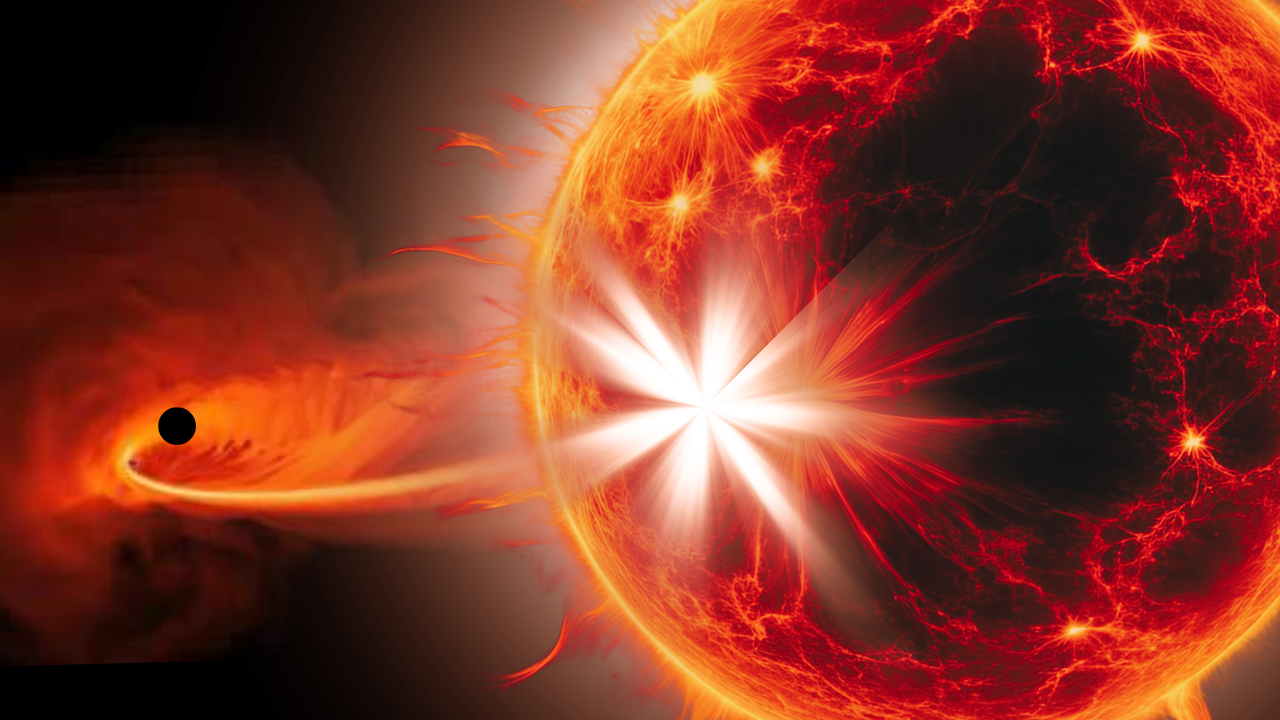
Some stars survive close encounters with supermassive black holes—but return for repeated rounds of stellar stripping. In certain cases, the flashes produced by those encounters grow dimmer over time, and researchers from Syracuse University say the star’s own spin may help explain why.
The events are known as repeating partial tidal disruption events, or rpTDEs. During each passage, a supermassive black hole pulls material from a star without destroying it completely. The stripped material gathers near the black hole and produces a flare of light.
Researchers had already found that a star’s internal structure affects how much material it loses. A lower-mass star, with a less concentrated structure, can surrender material from deeper inside. A more massive star tends to lose its outer layers first while its core remains more resistant. As those outer layers are depleted, later encounters can provide less material to feed the black hole.
That process alone, however, did not explain why four of the 10 currently known rpTDEs show fading flares, according to the Space.com report. Earlier work by the team found that the black hole’s gravitational pull also spins the star faster during each encounter. The increased rotation can shorten the time between passages, helping keep the flares relatively bright.
The new research adds another possibility: some stars may already be rotating rapidly before their first close approach. In that case, the black hole’s tidal torque would produce a smaller additional increase in spin. The star would not return on increasingly shorter intervals, so the progressively smaller amounts of stripped material could lead to diminishing flares.
The researchers also suggest a possible origin for these rapidly spinning stars. Most stars exist in binary systems, and a close binary passing near a supermassive black hole can be torn apart through a process called Hills capture. One star may be ejected while the other becomes bound to the black hole in a tight orbit. If the original pair was closely bound, the captured star could be left spinning rapidly and orbiting the black hole every few months.
The team said this same process may help explain several unusual features of rpTDEs. The findings could also have implications for the fast-moving stars orbiting Sagittarius A*, the supermassive black hole at the center of the Milky Way, although it is not currently undergoing a repeating partial tidal disruption event.
The research was published August 18 in The Astrophysical Journal.
/https://tf-cmsv2-smithsonianmag-media.s3.amazonaws.com/filer_public/b8/5e/b85ec0c4-468f-4a60-9021-4a6d41a63e39/alfie-bailey.png)
/https://tf-cmsv2-smithsonianmag-media.s3.amazonaws.com/filer_public/e5/b0/e5b0937c-4bba-4ace-9003-b19dc09f3f1e/when-male-suitors-abou.jpg)