Daily Weird News Report
A drone inspired by a cat’s claws has demonstrated an unusual ability: landing on and gripping steep ice walls instead of sliding away.
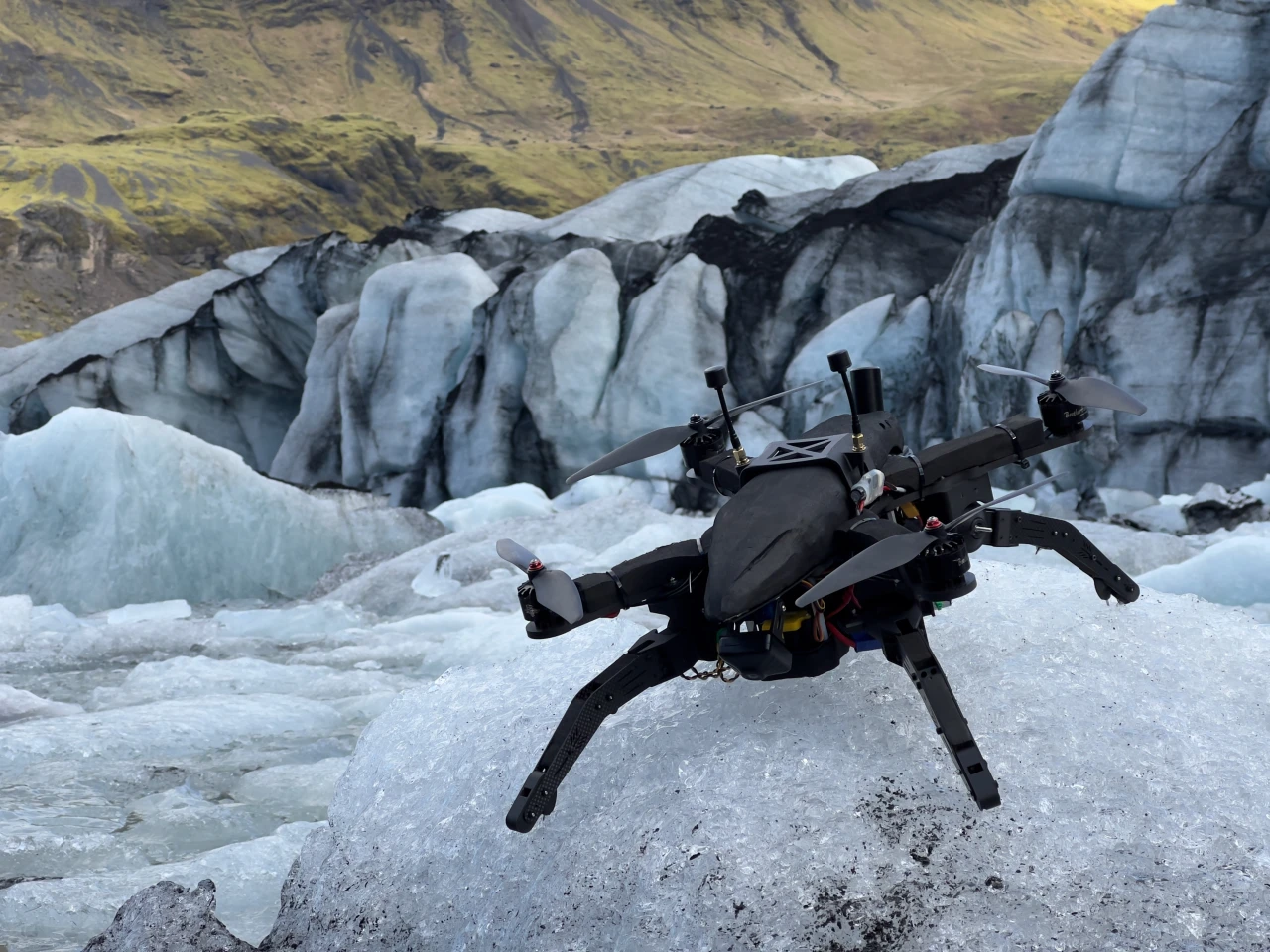
Called the Ice Dart, the quadcopter was designed by researchers at the Université de Sherbrooke in Quebec. According to the team’s paper in IEEE Transactions on Field Robotics, it is the first drone reported to perch on ice surfaces with angles approaching 60 degrees.
The 2.65-kilogram aircraft uses four carbon-fiber legs, each ending in a foot equipped with two spring-loaded spines pointing in opposite directions. The arrangement allows one spine to engage whether the drone lands facing uphill or downhill. The spines were inspired by cat claws, which deploy only when needed.
Landing on ice requires more than sharp feet. The drone’s gear contains 38 friction disks designed to absorb impact and prevent bouncing. Immediately after contact, its motors briefly reverse thrust, pushing the aircraft toward the wall and helping the spines penetrate the ice. The legs must remain compressed for the gripping system to work.
During field testing at Iceland’s Fjallsjökull glacier, the Ice Dart completed 24 landings on slopes of up to 58 degrees. The tests took place in temperatures from 0 to 10 degrees Celsius, with wind gusts exceeding 30 kilometers per hour. In controlled laboratory testing, it landed at speeds of up to 3 meters per second on slopes reaching 60 degrees.
The researchers say the design could allow drones to remain in harsh environments for much longer than they can while hovering. Once perched, a drone could shut down its noisiest systems and function as a stationary sensor, conserving energy while monitoring icebergs, maritime conditions, or environmental changes.
The system is not yet autonomous. The Iceland trials involved a human pilot and a second drone used for visual inspection. The Ice Dart also has not been tested on a drifting iceberg in open water, one of the situations where the researchers say the technology could be especially useful. Autonomous landing and testing in those conditions remain future steps for the project.