
Daily Weird News Report
Tiny robots that have no motors, batteries or propellers of the conventional kind have been made to move using sound waves alone, according to research reported by Live Science.
The devices rely on a principle known as Helmholtz resonance, the same effect that produces a tone when someone blows across the opening of an empty bottle. In the new robots, precisely shaped hollow chambers resonate when exposed to the right frequency. The resulting pressure creates a small jet of air that can generate thrust.
Researchers at the Swiss Federal Technology Institute of Lausanne, or EPFL, used two-photon 3D printing to produce the miniature structures. Laboratory tests and computer simulations indicated that the resonators generated thrust as predicted. Because the chambers respond to ultrasonic frequencies, the sound can be focused more precisely than audible sound, according to study co-author Selman Sakar.
The team tested the idea in several forms. Small boats measuring about 2 inches, or 5 centimeters, were equipped with multiple resonators, each tuned to a different frequency and aimed in a different direction. Changing the pitch from a nearby speaker allowed the researchers to steer the boats left, right or straight ahead.
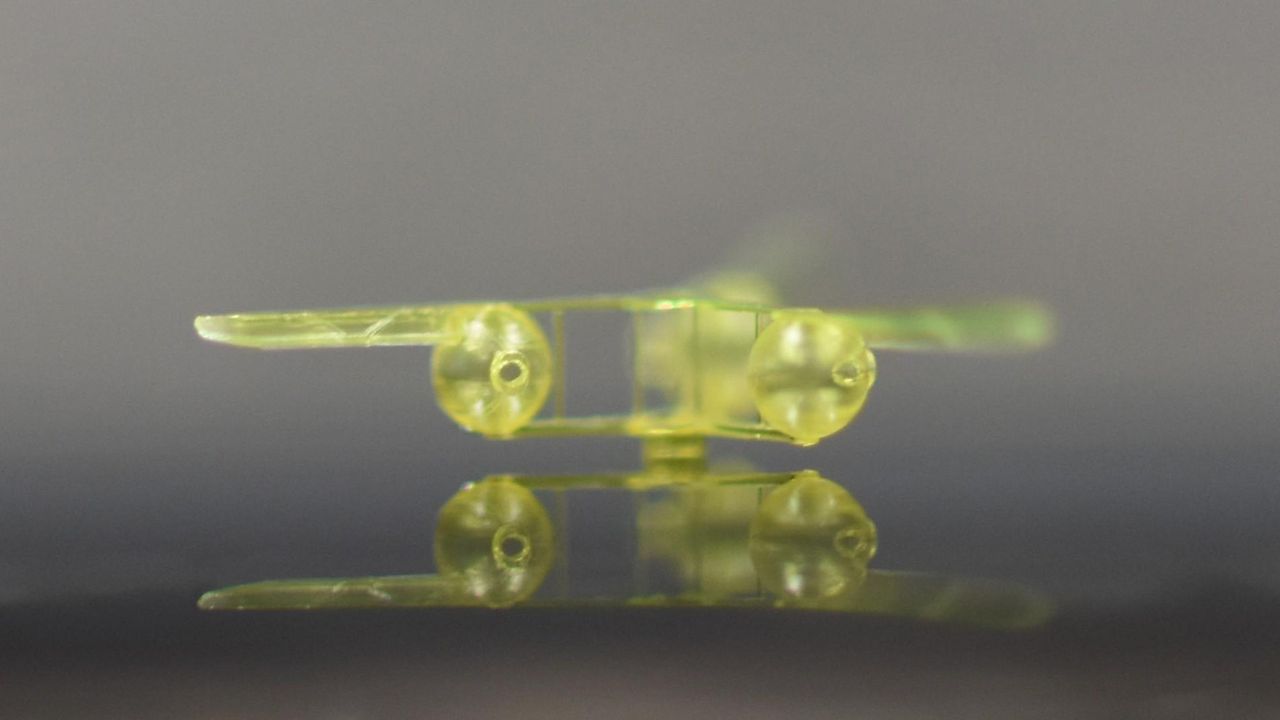
The researchers also built microfliers, some only about 0.04 inches, or 1 millimeter, across. One design produced lift by pushing air downward in a rocket-like arrangement. Another used sound-driven resonators to rotate tiny attached blades in a helicopter-like flight system.
The approach may avoid a size constraint faced by traditional motors, which require physical components including magnets, coils and shafts. The researchers said hollow resonators could potentially be made even smaller, although the current work is primarily a demonstration of design principles.
The study, published Aug. 12 in Science Advances, also outlines possible future uses. The researchers said the technology might eventually help rotate or manipulate small objects without touching them, or operate flexible surfaces that change shape in response to particular frequencies. Possible biomedical applications mentioned in the study include sound-responsive structures for heart stents.
Further work is expected to focus on practical designs, control systems and navigation.