
Daily Weird News Report
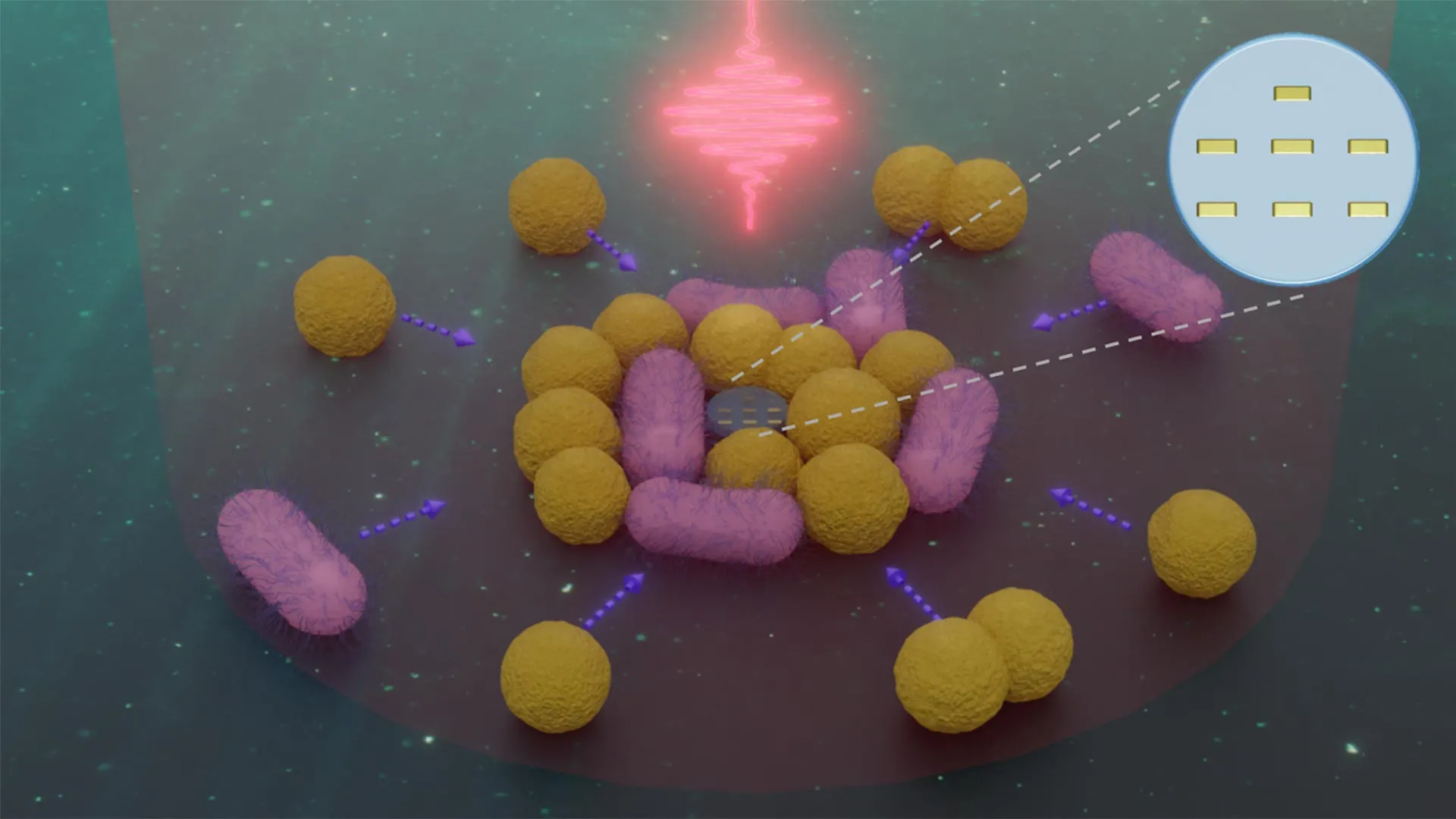
Researchers at Julius-Maximilians-Universität Würzburg have developed microscopic robots that can search for bacteria, collect them, transport them through liquid, and deposit them elsewhere. The light-powered devices are smaller than one micrometer—about 50 times narrower than the diameter of a human hair.
The work, reported by ScienceDaily from materials provided by the University of Würzburg, describes the robots as a possible way to manipulate cells and microbes that cannot be handled directly. The demonstrations were conducted under controlled laboratory conditions, where the devices gathered bacteria from one part of a sample and released them at chosen locations.
The robots move using photon recoil. Their plasmonic nanoantennas absorb light of a particular color and helicity before emitting it in a specific direction. Redirecting the photons produces a minute recoil force, but the robots’ extremely low mass allows that force to propel them.
To steer the smaller devices, the researchers incorporated nanoscale antenna wires that tend to align with the polarization of incoming light. Changing the light’s polarization changes the robot’s orientation while photon recoil continues to push it forward. This approach allowed the team to simplify the steering system without giving up light-based propulsion.
According to the report, the nanorobots can execute rapid 90-degree turns, enabling them to scan broad areas of a sample. They can also selectively capture, carry, and release substantial numbers of bacteria. The machines remain maneuverable while transporting larger groups, though their movement becomes slower as the load increases.
Lead experimental scientist Jin Qin described the devices as operating almost like microscopic cleaning machines. University of Würzburg researcher Bert Hecht said the project demonstrates that light can be used not only to observe microscopic environments but also to actively manipulate them.
The researchers said the demonstrated capabilities could eventually support work in microbiology, biomedical research, and the precise handling of microscopic materials. The study, “A nanoscale robotic cleaner,” was published in Nature Communications.
/https://tf-cmsv2-smithsonianmag-media.s3.amazonaws.com/filer_public/37/31/37310244-a744-4aff-883f-644ac47266a4/brianhie_image_2024-3.png)