Daily Weird News Report
Greenland sharks can live for as long as 400 years, and new research suggests their eyes may remain remarkably well preserved across much of that lifespan.
The study, led by University of California, Irvine researcher Dorota Skowronska-Krawczyk and published in Nature Communications, examined the visual systems of Greenland sharks caught near Disko Island, Greenland, between 2020 and 2024. Researchers preserved and dissected the animals’ eyes for laboratory analysis.
The team found no evidence of retinal cell death in the examined tissue. The sharks also retained active rhodopsin, a protein involved in seeing in low light. According to the research, the protein appears tuned to blue light, which is especially useful in the dim underwater environment where Greenland sharks live.
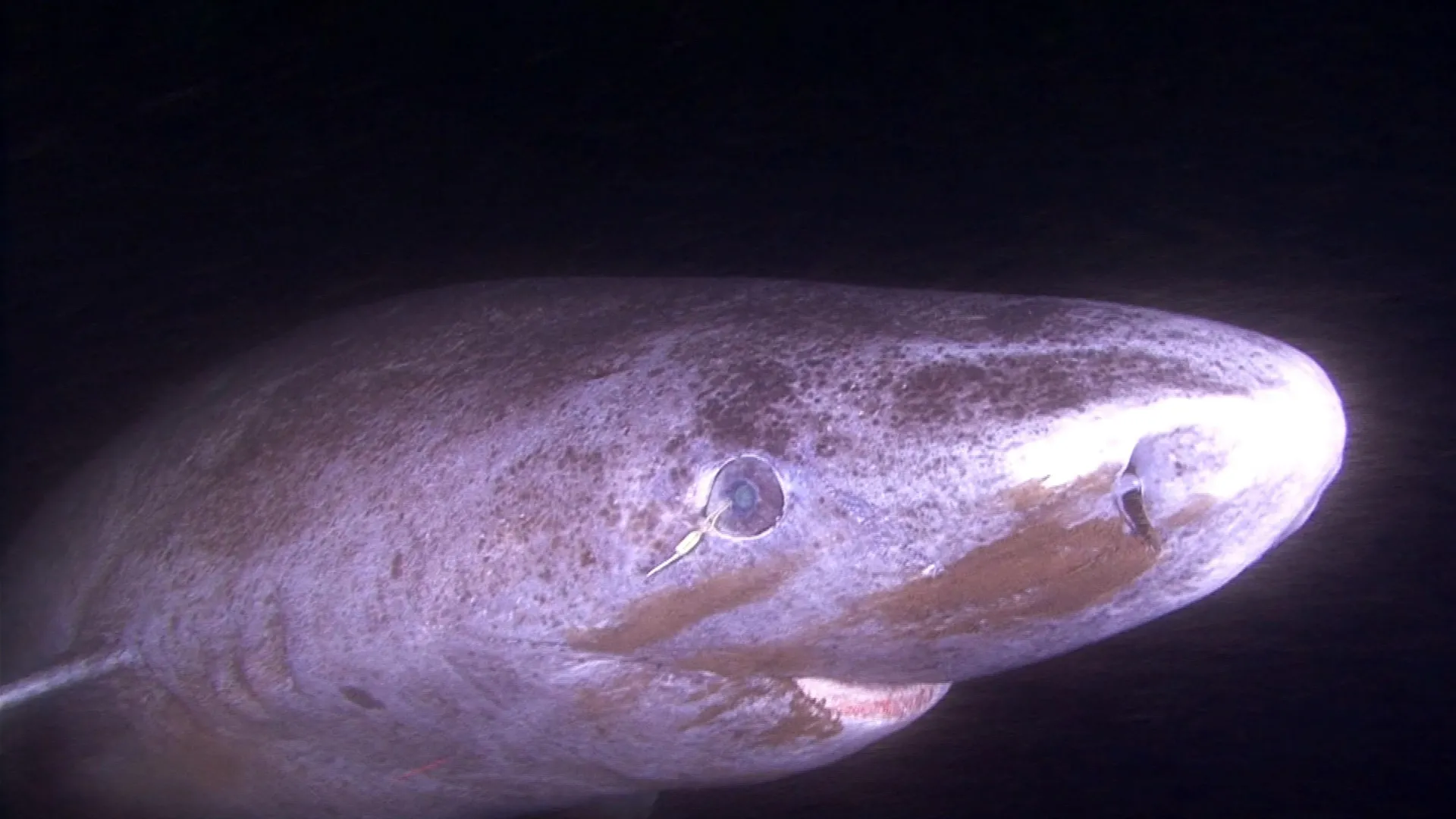
The findings challenge earlier assumptions about the species’ vision. Greenland sharks have cloudy-looking eyes, and parasites are often found attached to their eyeballs. Combined with the dark, murky Arctic waters they inhabit, those characteristics had led scientists to suspect that the sharks might be functionally blind.
That view began to change when Skowronska-Krawczyk observed video of a Greenland shark moving its eye toward a light source. The behavior prompted a closer investigation of the animals’ visual system.
The researchers propose that DNA repair mechanisms may help the sharks preserve their eyesight over exceptionally long lives. However, the study does not establish that these mechanisms can be used to prevent human eye disease.
The work could eventually help guide research into age-related conditions such as macular degeneration and glaucoma, according to the University of California, Irvine. It also raises broader questions about how tissues remain functional for centuries and how vision adapts to extremely low-light environments.
The researchers’ conclusions concern the eye tissue and molecular features they examined; they do not show that every Greenland shark experiences identical vision or avoids all eye damage. Still, the results provide evidence that an animal once suspected of being nearly blind possesses a functioning visual system capable of operating in the Arctic deep.
/https://tf-cmsv2-smithsonianmag-media.s3.amazonaws.com/filer_public/cc/a5/cca51174-4295-4234-b8d2-eab719894c73/screenshot_2026-08-24_at_171648.png)