Daily Weird News Report
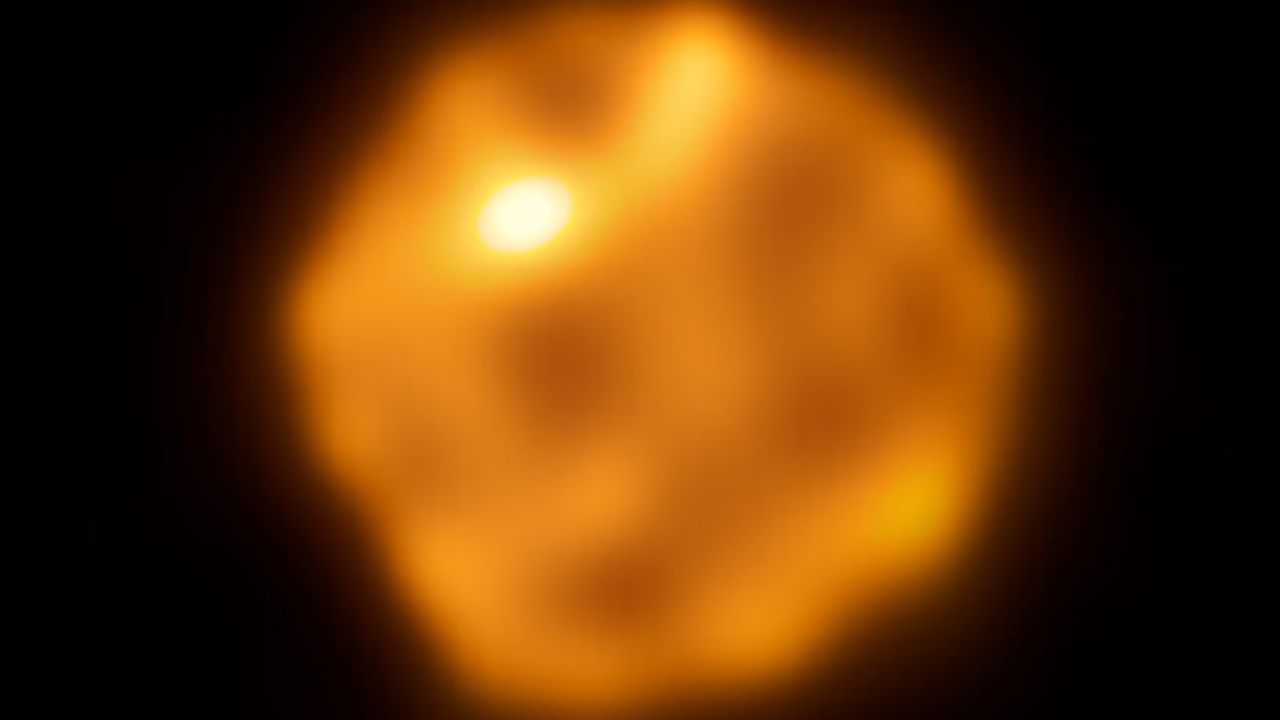
Astronomers have captured an unusually detailed view of Betelgeuse, the massive red supergiant located about 600 light-years from Earth. Observations made with the Atacama Large Millimeter/submillimeter Array, or ALMA, reveal a turbulent surface marked by bright hotspots and an uneven, almost corrugated appearance.
The images were collected in 2023 and examined alongside ALMA observations from 2015. Betelgeuse is estimated to have about 20 times the mass of the Sun while extending to roughly 800 times its size. Its atmosphere has a temperature of approximately 3,680 degrees Fahrenheit, or 2,030 degrees Celsius, but the observations identified at least two regions that are hotter.
One hotspot is about 980 degrees Fahrenheit, or 530 degrees Celsius, warmer than the surrounding plasma. Researchers say the surface irregularities are likely associated with enormous convective movements inside the star. Hot plasma rises through Betelgeuse, producing shockwaves that reach its atmosphere and create hotter, brighter areas.
The observations also produced a surprise. A hotspot in the northeastern part of Betelgeuse appeared in the same position in images taken more than seven years apart. According to the Space.com report, that persistence is longer than current stellar models predicted, suggesting that some surface structures may survive for an extended period.
The arrangement of the hotspots also lends support to the possibility that Betelgeuse has an orbiting companion star, although the source describes that object as elusive rather than confirmed.
Betelgeuse drew widespread attention several years ago when it dimmed dramatically. Some scientists then suggested the change could indicate that the star was nearing a spectacular supernova explosion. That event has not occurred, and scientists are now less convinced that an explosion is immediately approaching. The star’s eventual fate is still expected to be a supernova, making its present-day behavior a continuing focus of observation.
The research team plans to keep monitoring Betelgeuse with ALMA, particularly to track whether the hotspots remain fixed and how they change. The study has been accepted for publication in Astronomy & Astrophysics and is available through arXiv.