Daily Weird News Report
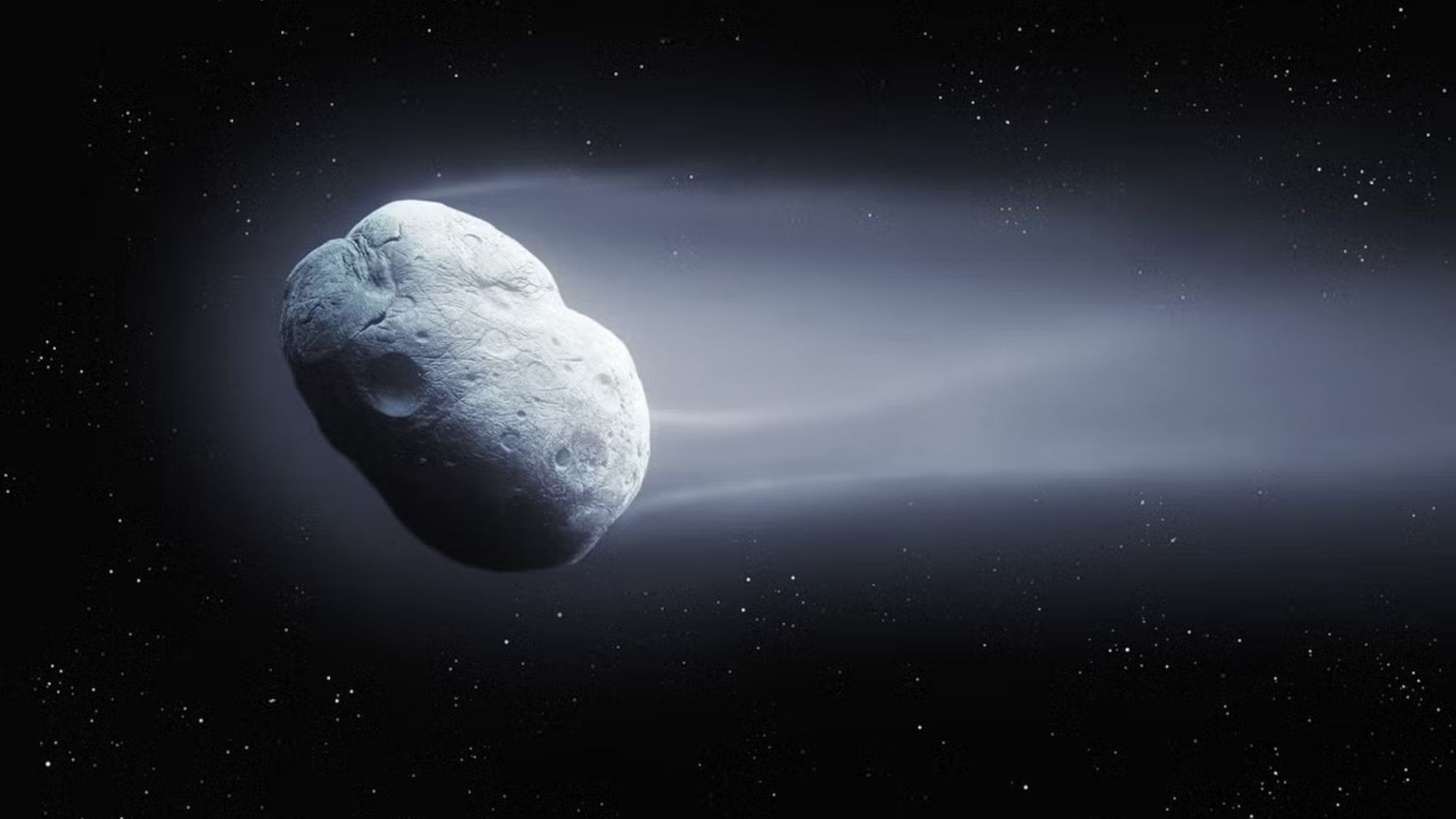
Astronomers have observed an icy object known as 450P/LONEOS developing comet-like activity, providing a rare glimpse of a possible transition between an inactive outer-solar-system body and a comet.
450P is classified as a centaur, a type of object that travels around the sun between Jupiter and Neptune. These bodies are thought to have originated beyond Neptune and to follow unstable paths that can be altered by the gravity of the giant planets. Such encounters may send them closer to the sun or remove them from the solar system.
Using the Gemini North telescope in Hawaii, researchers led by planetary scientist Charles Schambeau of the University of Central Florida watched a cloud of gas and dust, called a coma, form around 450P’s solid nucleus. The coma became brighter between 2019 and 2024, as the object reached the closest point in its orbit to the sun.
The team also used the James Webb Space Telescope to examine the coma. Those observations detected carbon dioxide gas and indications of crystalline water-ice and dust particles. No water vapor was detected, suggesting that carbon dioxide, rather than ordinary water-ice sublimation, is driving the object’s current activity at its distance from the sun.
Researchers linked the change in 450P’s orbit to a close encounter with Saturn in 1992, when the object passed within about 2.9 million miles of the planet. Saturn’s gravity significantly shortened the orbit, bringing 450P’s closest solar approach to about 5.4 astronomical units, or roughly 506 million miles from the sun—just beyond Jupiter’s orbit.
The additional solar heating may be altering ice and trapped gases beneath the surface. The possible presence of crystalline ice is important because it could indicate that previously unstructured, or amorphous, ice has been heated and changed. During that process, escaping gases can carry dust and ice particles away from the surface.
450P’s orbit currently takes about 22 years, so it is not yet a Jupiter-family comet, which has an orbital period of less than 20 years and is influenced by Jupiter. Researchers say another gravitational encounter with a giant planet could eventually move it into that category.
The findings have been accepted for future publication in the Planetary Science Journal and are currently available on the arXiv preprint archive.