Daily Weird News Report
Space that appears empty may still influence light. Researchers studying the magnetar 1E 1547.0-5408 have found evidence consistent with vacuum birefringence, a quantum effect predicted nearly 90 years ago by Werner Heisenberg.
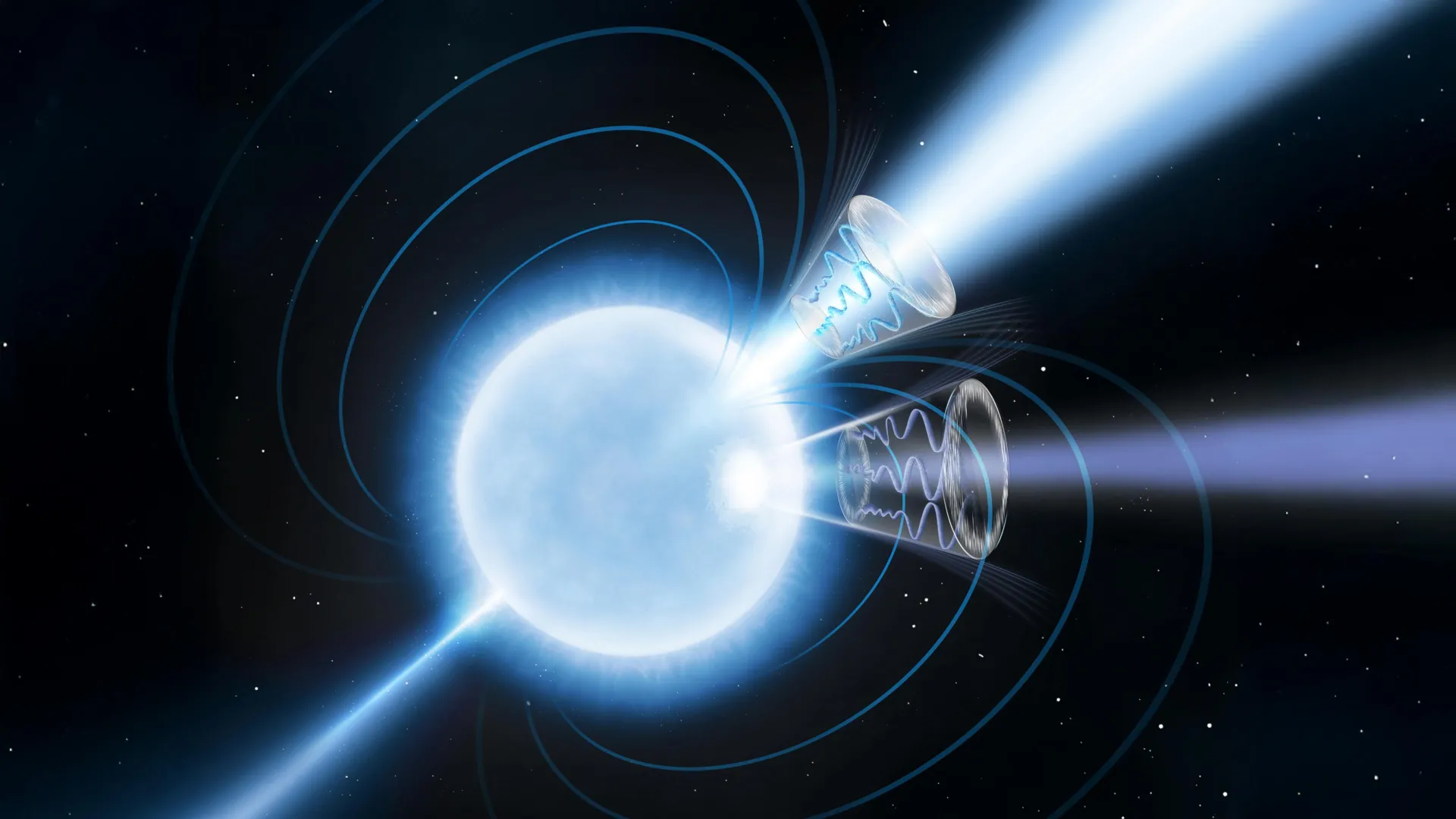
The phenomenon is expected to occur when an exceptionally powerful magnetic field affects the “virtual particles” associated with a vacuum. Those particles are not directly observed, but quantum theory predicts that their behavior could change the way light travels through space, producing a measurable change in its polarization.
Magnetars are unusually suitable places to search for the effect. They are neutron stars with the strongest known magnetic fields in the universe—fields that, according to the researchers, can be more than 100 million times stronger than any produced on Earth.
An international team examined 1E 1547.0-5408 using NASA’s Imaging X-ray Polarimetry Explorer. The observations were supported by the NICER X-ray telescope aboard the International Space Station and the Murriyang radio telescope at CSIRO’s Parkes Observatory. Radio measurements were collected and analyzed with assistance from Swinburne University of Technology.
The team tracked how the magnetar’s radio waves changed as the star rotated. Those measurements indicated that its magnetic and rotational axes are nearly aligned, while the star is viewed from a perspective close to one of its poles. The researchers said this geometry provided an unusually favorable opportunity to test for the predicted effect.
X-rays detected by IXPE showed very high polarization. Their polarization direction also remained linked to the magnetar’s magnetic field in a pattern consistent with the radio observations. Together, these features produced what the researchers described as the most definitive signal so far of vacuum birefringence.
The result is not yet a definitive detection. Additional observations and more advanced computer simulations are needed to determine whether the signal comes from the quantum effect or from other processes around the magnetar. The research was published in Nature under the title “Vacuum birefringence and the polarized X-ray emission from a radio magnetar.”