Daily Weird News Report
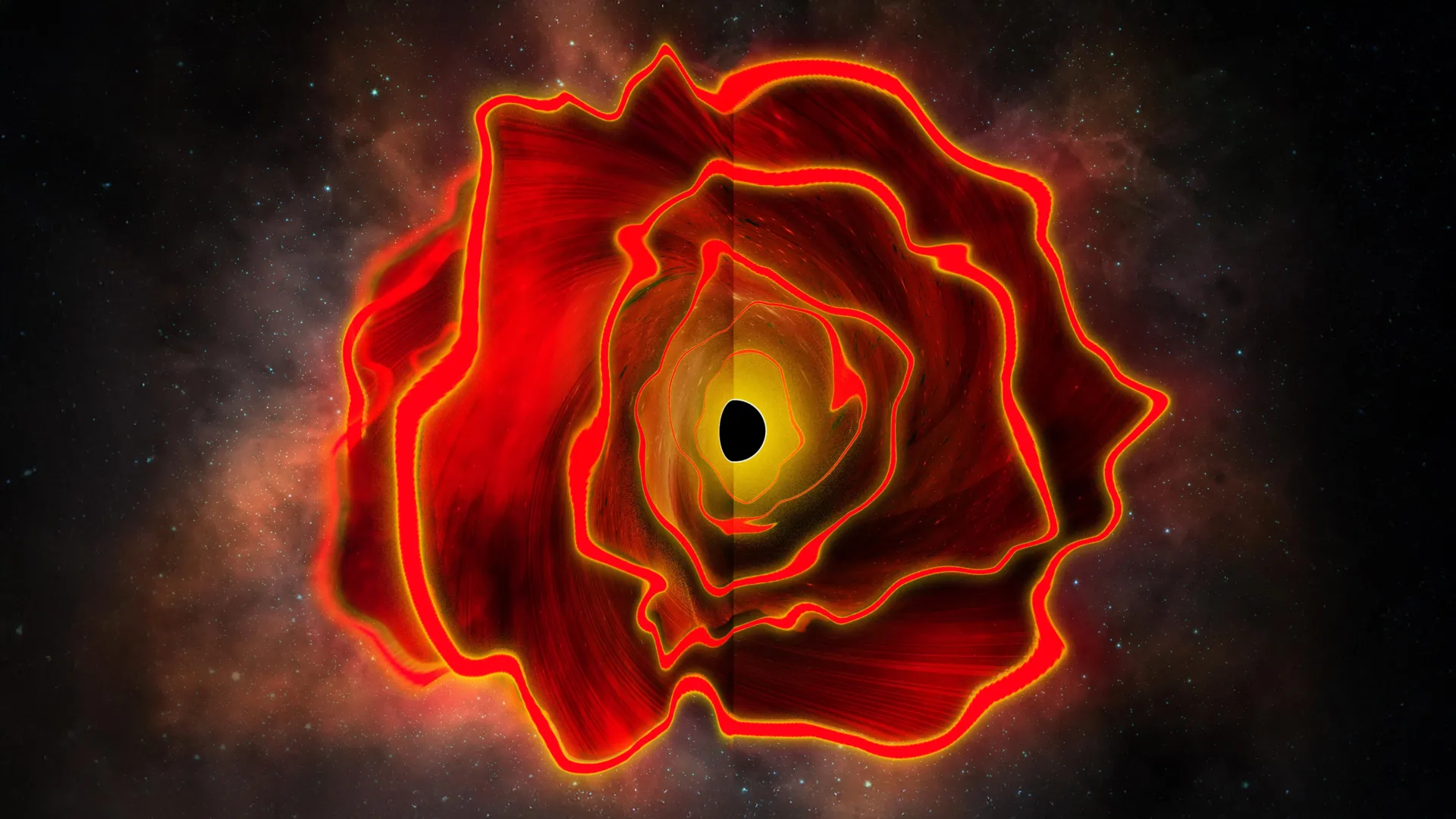
A remarkably bright red object spotted by the James Webb Space Telescope may represent a previously unknown kind of cosmic structure: a black hole wrapped in a vast, star-like shell of gas.
The object, named MoM-BH*-1, dates to a period only a few hundred million years after the Big Bang. According to reporting from ScienceDaily on research by astronomers at MIT and other institutions, it appears roughly comparable in size to the solar system but produces about 100 billion times more energy than any known star could generate through ordinary nuclear fusion.
That combination of an enormous, star-like appearance and extreme brightness led the researchers to propose the name “black hole star.” Their study, published in Nature, describes a model in which a black hole roughly 100,000 times as massive as the Sun is hidden inside a dense envelope of hydrogen.
The object was found during a James Webb Space Telescope survey seeking some of the earliest galaxies. Researchers initially noticed that the source was unusually red and bright. Its spectrum contained a particularly strong “Balmer break,” a sharp drop in light at certain wavelengths. Although this feature can be associated with dense gas in stellar atmospheres, the break was stronger than any the researchers had observed, according to the report.
The source also showed little evidence of elements heavier than hydrogen and helium. The team tested several explanations with computer simulations, including a dense, dust-free cloud of hydrogen. Those models could reproduce some of the object’s unusual characteristics, but not its immense energy output through stellar fusion alone.
Adding an actively feeding black hole to the model produced the closest match to the James Webb observations. The researchers therefore say the black hole-star interpretation is the most likely explanation presented by their analysis, rather than a confirmed identification of a new class of object.
The team also suggests that similar structures could account for many of the small, bright red objects—known as “little red dots”—seen in James Webb images of the early universe. However, MoM-BH*-1 appears unusual even among them because its light may overwhelm that of its surrounding host galaxy. Whether the proposed object is the first member of a broader population remains an open question.