
Daily Weird News Report
A faint object called Cloud 9 could be the closest astronomers have come to identifying a galaxy made almost entirely of gas and dark matter, according to reporting by Space.com.
Cloud 9 lies about 14 million light-years from Earth near the spiral galaxy Messier 94. Observations indicate that it contains hydrogen gas with an estimated mass roughly one million times that of the sun, along with about five million solar masses of dark matter. Yet the Hubble Space Telescope found virtually no starlight coming from the object.
That combination makes Cloud 9 a leading candidate for a “starless” or “failed” galaxy—a structure with the raw material needed to form stars but no significant stellar population. Such objects have been predicted theoretically, but confirmed examples have remained elusive because stars are normally what make galaxies visible.
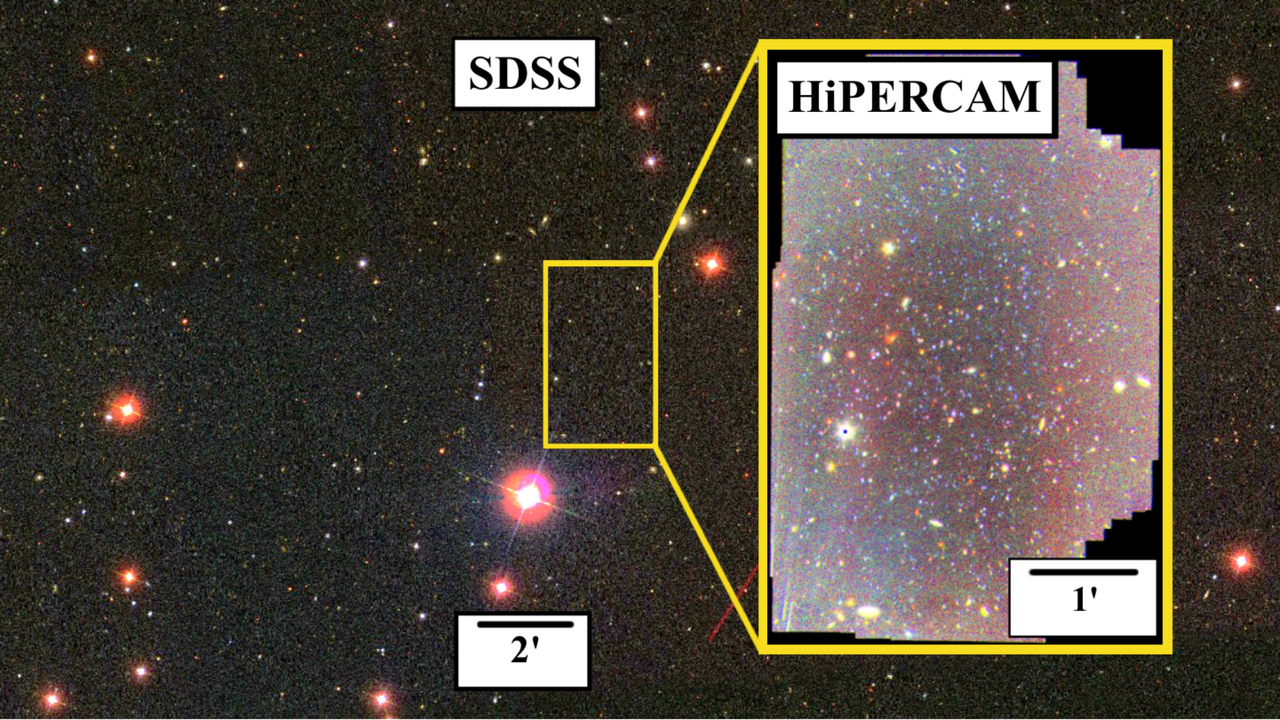
To investigate the object, Ignacio Trujillo of Spain’s Instituto de Astrofísica de Canarias and colleagues used the HiPERCAM camera on the Gran Telescopio Canarias. Their observations produced images of the region about 10 times deeper than earlier optical imaging, after approximately 2.36 hours of exposure.
The team reported no detectable stellar emission at Cloud 9’s location. Even under the assumption that any stars would be old and poor in heavy elements—conditions that would make them especially difficult to see—the researchers calculated that the object contains no more than about 16,000 solar masses of stars.
The findings do not yet establish that Cloud 9 is definitively the first starless galaxy. Deeper space-based observations could help determine whether a very faint stellar component exists. The researchers said the James Webb Space Telescope might contribute to that effort, depending on the filters and stellar indicators used.
One proposed explanation involves the ultraviolet radiation that filled the universe after the epoch of reionization. According to this idea, the radiation heated gas inside small dark-matter halos, preventing it from cooling and collapsing into stars. The team said Cloud 9’s estimated halo mass is consistent with that theoretical regime.
The research has been made available on the arXiv paper repository, while the object’s status remains under investigation.


/https://tf-cmsv2-smithsonianmag-media.s3.amazonaws.com/filer_public/f0/fe/f0fe19e4-e68b-474d-b0a4-19c5beb9d19d/speedy-star.webp)