
Daily Weird News Report
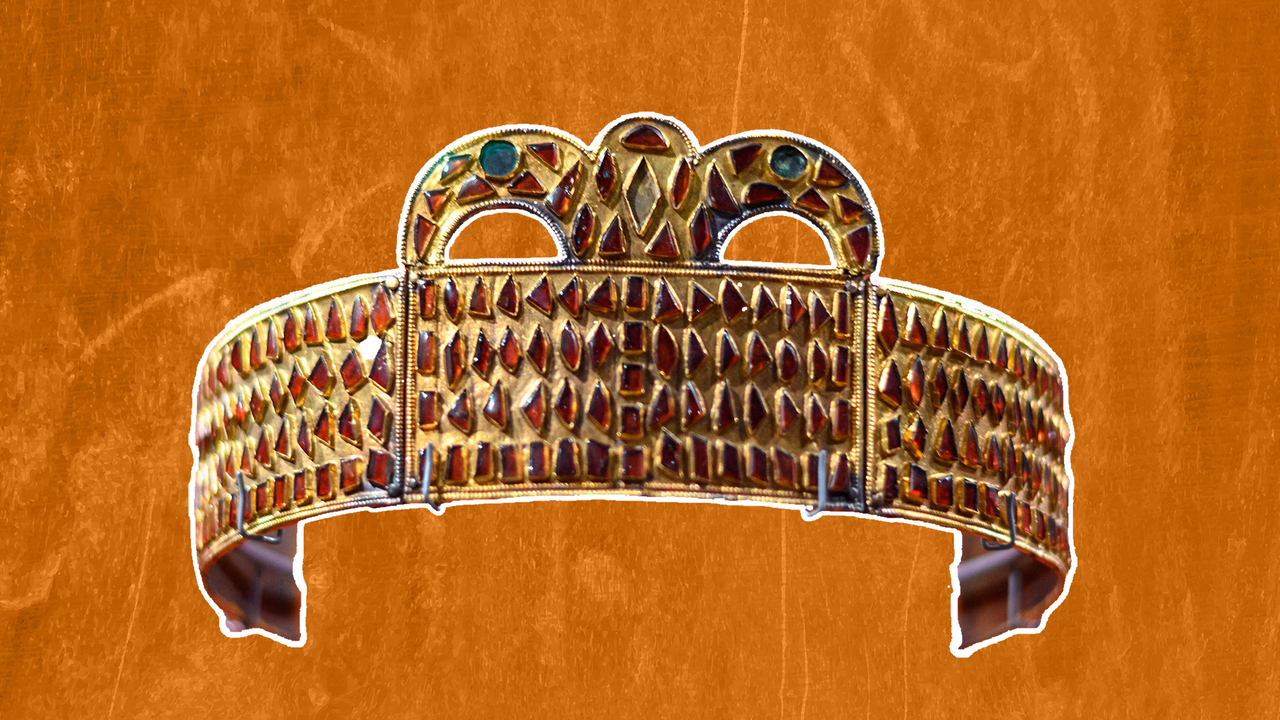
A small gold diadem found in an ancient burial near Crimea’s Kerch Peninsula has survived as one of the most striking objects associated with the Huns. Known as the Crown of Kerch, the roughly 1,600-year-old ornament is now part of the collection at Berlin’s Neues Museum.
The artifact was discovered in the early 20th century during excavations of Pantikapaion, an ancient city founded as a Greek colony in the sixth century B.C. The site was later conquered by the Huns, who moved west from the Don River region in the late fourth century A.D. A large necropolis containing as many as 2,000 burials was excavated there, although only a small number of artifacts and skulls were preserved.
The diadem consists of three gold-covered bronze plaques and more than 250 cells set with gems. Its band is approximately 4.4 centimeters tall. Two stylized birds of prey—likely eagles—face inward from either side of a central floral design, with round green stones forming their eyes.
According to the museum, birds of prey were associated with power and authority among the Huns and other groups of the period. Similar imagery also appeared on jewelry worn by Visigoth women in sixth-century Spain.
Live Science reports that the diadem was recovered from the grave of a high-status woman. German archaeologist Joachim Werner wrote in a 1956 study that the burial chamber also contained the skeleton of a woman whose skull had been artificially modified. He argued that the ornament was not merely a funerary object, but may have been worn during her lifetime, perhaps with a cloth cap or veil attached.
Its name and elaborate construction might suggest a queen’s crown, but the surviving archaeological record points to a less exclusive role. Around two dozen comparable gold diadems have been discovered, leading to the interpretation that the Crown of Kerch represented membership in the ruling Hun elite rather than formal royal insignia.
The diadem was acquired by a German art collector after the excavation, along with dozens of other objects from the site. It remains an unusual surviving example of the jewelry and status symbols associated with elite women in the late fourth or early fifth centuries.

/https://tf-cmsv2-smithsonianmag-media.s3.amazonaws.com/filer_public/ce/3a/ce3ad4ec-2ba5-4000-badb-8ce3dc4cdf41/metal.png)
