
Daily Weird News Report
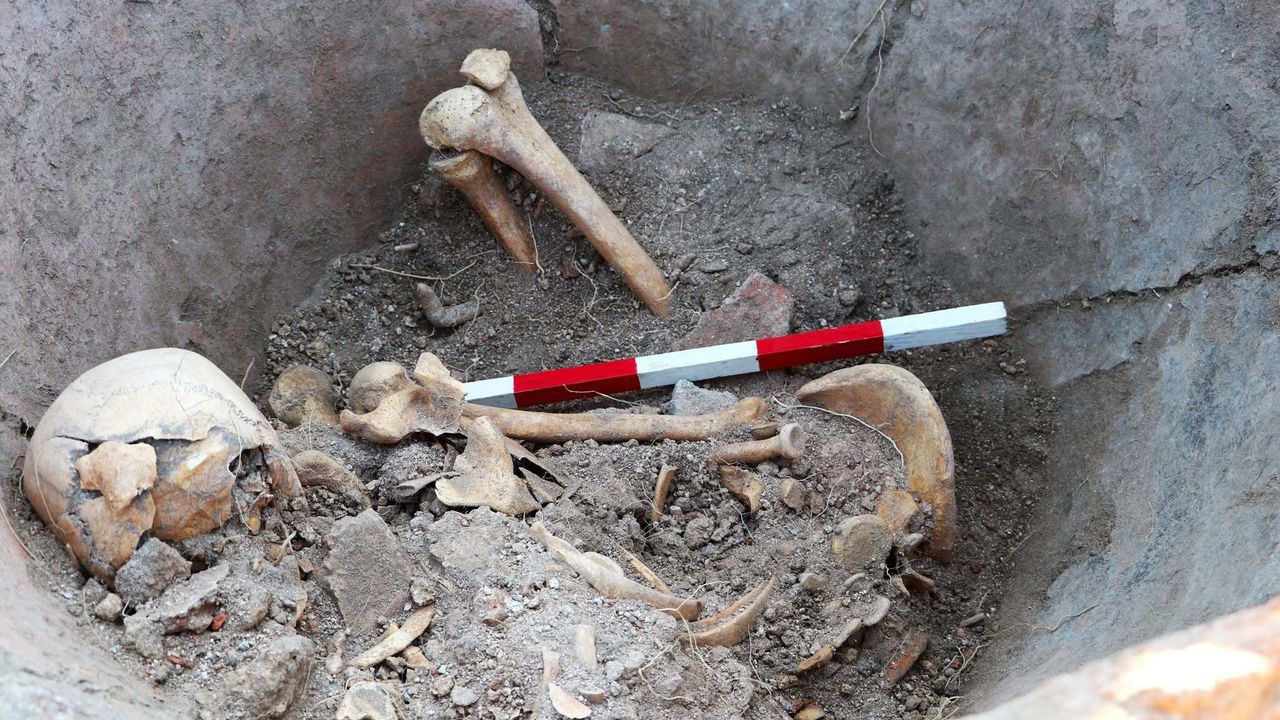
A human skeleton discovered inside a giant Roman storage jar may be the remains of someone who took refuge there during an attack more than 1,600 years ago, according to reporting by Live Science.
The find was made on Aug. 10 in a Late Roman turret at Deultum, a Roman colony in what is now Bulgaria. The vessel, known as a dolium, was found at the bottom of the structure’s northern turret near the western Roman gate. Its surviving lower section was about 3 feet, or 1 meter, across.
Archaeologist Lyudmil Vagalinski of the Bulgarian Academy of Sciences told Live Science that the individual was probably a young man who climbed into the empty jar as violence and fire spread through the site. The remains were found with two iron knives—one in a belt and another apparently held between the legs—along with a belt.
The interpretation is based partly on evidence of extensive burning around the vessel. Excavators reported ashes and coals, blackened walls, melted glass, broken bricks and roof tiles, and the bones of domestic animals. They also found numerous bronze coins, which may have been dropped during the disorder.
Vagalinski said ashes beneath the skeleton suggest the person entered the dolium after the fire had started. The body’s position resembled that of a sleeping person, and the researchers found no indication that the individual tried to climb out.
The exact attack responsible has not been identified. Deultum experienced attacks by East Germanic tribes and Huns during the fourth and fifth centuries, but the team’s preliminary dating places this particular event at approximately A.D. 400. A more precise date is expected after additional field data is processed.
According to Live Science, the city’s inhabitants later leveled the damaged turret and laid a new, higher floor over the ruins, apparently without realizing that the body remained inside the jar. The discovery was unexpected because human remains are rarely found within ancient cities except in unusual circumstances such as attacks, earthquakes, or volcanic eruptions.
The skeleton has been transferred to Sofia for examination by a physical anthropologist. Archaeologists plan to return to Deultum next summer to continue investigating the turret and the wider western gate, which dates to about A.D. 300.
/https://tf-cmsv2-smithsonianmag-media.s3.amazonaws.com/filer_public/cb/7b/cb7bd306-9a69-40e6-a11f-785d40ffd523/w020260827331834563059_origin.jpg)