
Daily Weird News Report
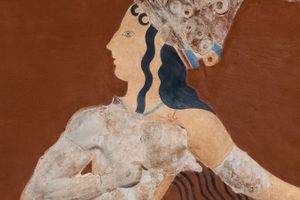
The slender figure known as the Prince of the Lilies has become one of the most recognizable images associated with Minoan Crete. Reproduced on postcards, book covers, and museum posters, it is typically shown as a crowned man walking through a garden with one hand resting on his chest.
The conventional interpretation presents him as a king—or possibly a priest-king—at Knossos around 1500 BCE. Yet the figure displayed in that familiar form is largely the product of reconstruction, according to reporting by Atlas Obscura.
Archaeologists working with Arthur Evans in the early 1900s excavated fragments that included a torso, a crown, and separate body pieces. The surviving material may not have belonged to a single person. Émile Gilliéron, Evans’ restorer, assembled the pieces into one forward-striding male figure and filled substantial missing areas with plaster and painted additions.
Later scholars have questioned that arrangement. Some have suggested that the crown and torso could have come from two—or even three—different figures. Proposed alternatives include a female boxer and a sphinx-like composite creature, rather than the single princely man depicted in the widely circulated reconstruction.
The uncertainty surrounding the fresco reflects a larger debate over Evans’ work at Knossos. His reconstructions, made with concrete and paint, have been criticized as going beyond restoration and introducing elements of invention. In that view, the rebuilt palace helped promote a unified story centered on kingship and palace life, even though the social structure of the Minoan civilization remains poorly understood.
As a result, the “Prince of the Lilies” is not simply a portrait preserved from the Bronze Age. It is also an example of how incomplete archaeological evidence, restoration decisions, and later interpretation can shape the image of an ancient society.