
Daily Weird News Report
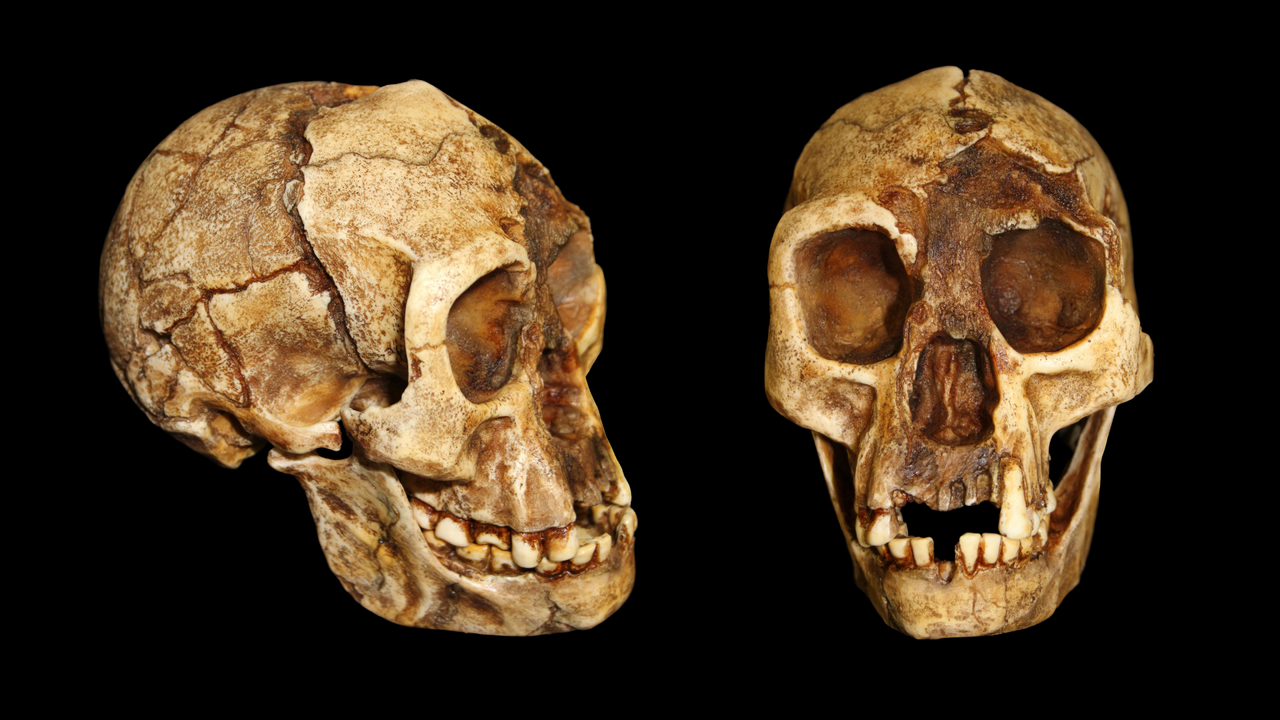
The extinct human relative Homo floresiensis may have walked in a more human-like way than some of its unusual skeletal features suggested, according to research reported by Live Science.
Researchers examined the pelvis of LB 1, an adult female specimen found on the Indonesian island of Flores. She stood about 3.5 feet (1 meter) tall and died between 100,000 and 60,000 years ago. The species was discovered in 2003 and has since presented researchers with a difficult evolutionary puzzle because its skeleton combines traits associated with humans and earlier australopithecines.
For the new study, published Aug. 25 in the American Journal of Biological Anthropology, researchers compared pelvic bones from apes, australopithecines, and living and extinct human species. They developed a quantifiable way to assess iliac flare—the extent to which the hip bones extend outward from the body’s center.
A pronounced iliac flare has been associated with australopithecine anatomy and less efficient upright walking. But the team found that LB 1’s pelvis was statistically closer to those of Pleistocene human species, including Homo erectus, than to australopithecines or apes.
The findings suggest that H. floresiensis probably used a form of two-legged walking broadly similar to that of humans. They do not indicate that the hobbits moved exactly like modern people. The researchers said the species was probably not especially fast, did not travel long distances, and may have retained some tree-climbing behavior.
Kristi Lewton of the University of Southern California, who worked on the study, told Live Science that the hip bones make H. floresiensis look generally like humans and other members of the genus Homo. Caley Orr, a paleoanthropologist at the University of Colorado Denver who was not involved in the research, said the results were consistent with earlier work that also found LB 1’s pelvis to be mostly human-like.
The pelvic evidence does not settle where the species came from. One possibility is that it descended from Homo erectus populations that became smaller after reaching Flores. Another is that it evolved from an earlier, already small-bodied Homo group. The study’s researchers said genetic or ancient-protein evidence could help resolve the question, but acknowledged that an answer may not come soon.