Daily Weird News Report
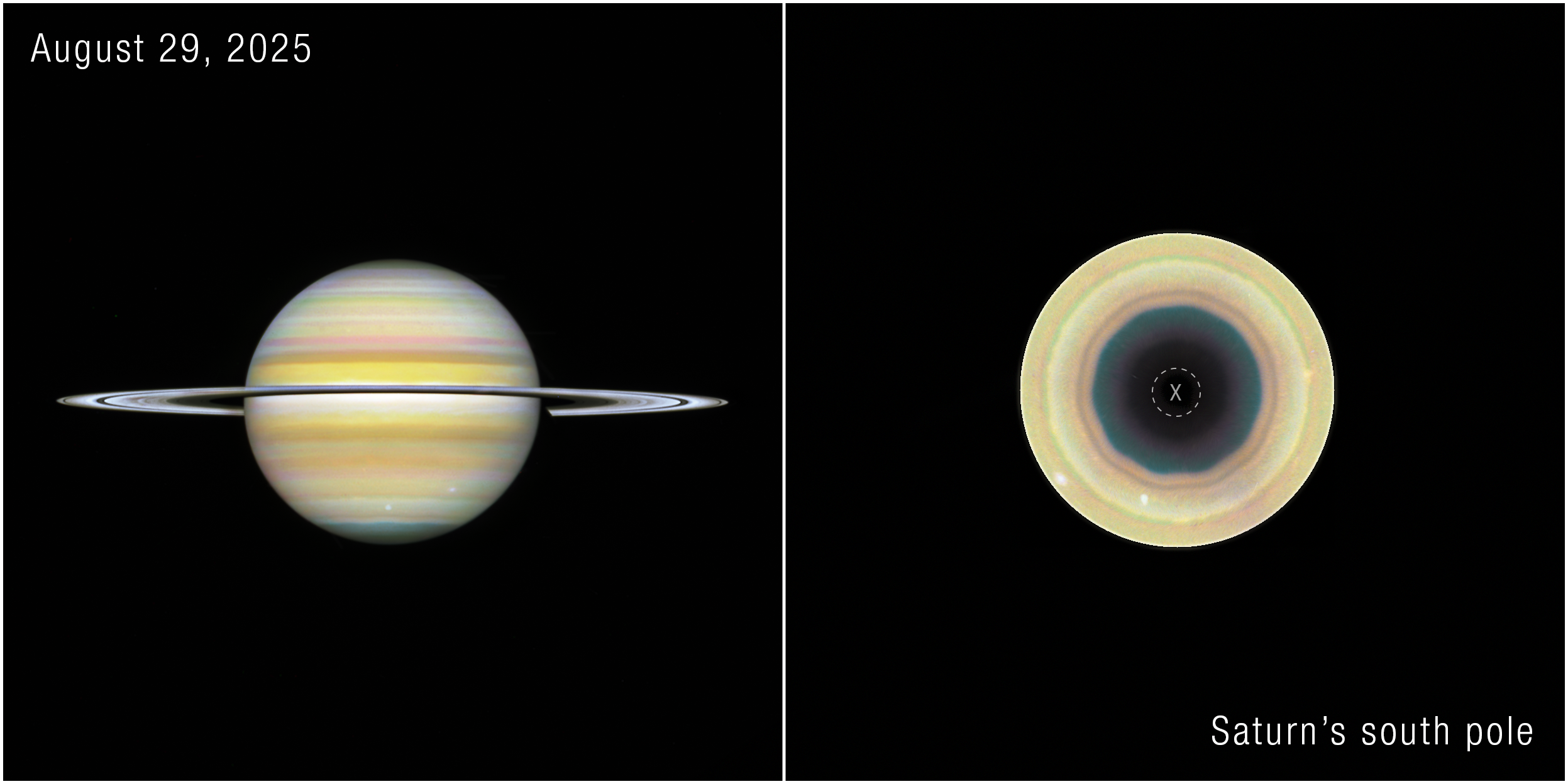
A giant atmospheric wave with 10 distinct sides is encircling Saturn’s south pole, according to observations from NASA’s Hubble Space Telescope. Researchers say it is the first large, regular-sided jet pattern observed in Saturn’s southern hemisphere.
The feature, described in a study published in Science Advances, was identified by combining Hubble images collected since 2023 with observations from ground-based telescopes. It appears within one of Saturn’s powerful jet streams and extends through several atmospheric layers, indicating that it is more than a feature visible only at the cloud tops.
The structure was first noticed in ground-based images from 2024, when lead researcher Agustín Sánchez-Lavega and amateur astronomers Trevor Barry and Jean-Paul Oger saw a subtle, undulating band near the southern pole. Additional images from 2025 provided stronger indications of a decagonal pattern.
Hubble’s sharper view from space helped confirm the feature and showed that it was present as far back as 2023. The telescope can observe Saturn through full rotations without the blurring caused by Earth’s atmosphere. Images taken at different wavelengths show slight shifts in the decagon’s apparent position because those wavelengths reveal different atmospheric altitudes.
The wave bears an apparent resemblance to Saturn’s famous northern hexagon, a persistent six-sided pattern observed for more than four decades. However, researchers emphasize that the southern feature is different: It appears to be strengthening and may have formed relatively recently. Images from NASA’s Cassini spacecraft, which orbited Saturn from 2004 to 2017, did not show evidence of a long-lived southern counterpart.
Scientists do not yet know why the decagon formed, how long it will remain, or whether it will settle into a stable pattern like the northern hexagon. The research team plans to continue monitoring Saturn with Hubble and NASA’s James Webb Space Telescope, alongside computer modeling, to investigate the wave’s development and the atmospheric forces driving it.