
Daily Weird News Report
What began as a question at a gaming convention dinner has produced an unusually precise set of dice: five 60-sided shapes designed to give players equal odds of determining the order of play.
According to Live Science, Auburn University mathematician Eric Harshbarger spent about 15 years working on the problem after board game designer James Ernest asked whether every player in a group could take one die, roll it and have an exactly equal chance of going first. The rules also required no ties or rerolls, regardless of how many people were playing.
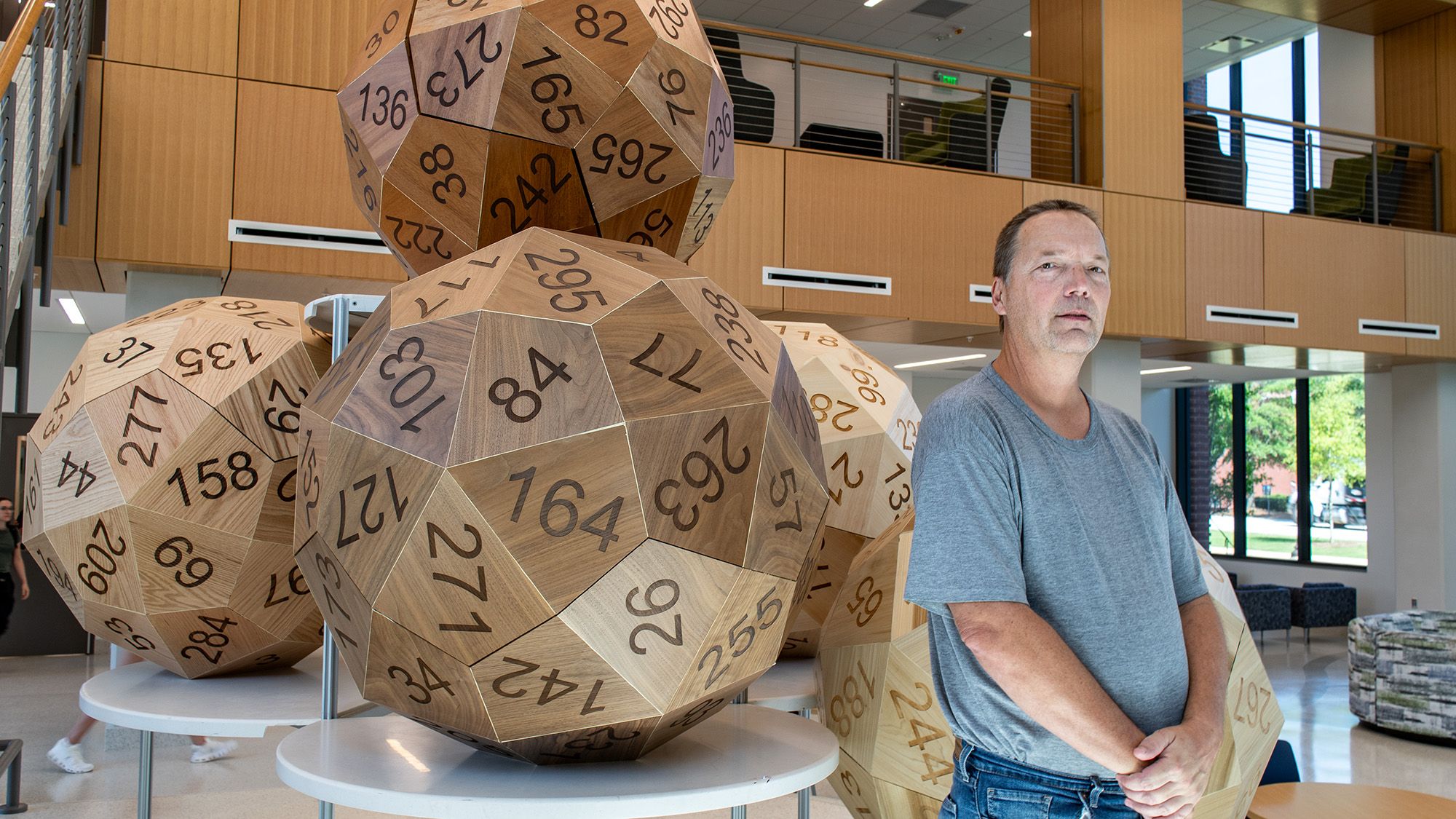
The challenge was not simply putting different numbers on each die. The numbers had to be distributed so that any group of players using any selection of dice would have equal chances. The final set contains five dice, each with 60 sides, and uses every number from 1 through 300 once.
The arrangement provides what Harshbarger and his collaborators call “permutation fairness.” That means the dice do more than identify the first player: every possible complete turn order is equally likely. A particular sequence of players has the same probability as any other sequence.
Harshbarger initially worked with mathematician Robert Ford, who helped develop a three-player arrangement using three six-sided dice. Ford later found a four-player solution using four 12-sided dice. Harshbarger eventually began making and selling handmade versions of the four-player set.
A five-player design proved far more difficult. Live Science reports that the number of possible arrangements was estimated at 10 to the 128th power, making a straightforward computer search impractical. The team instead looked for mathematical patterns and symmetries that could reduce the search.
The breakthrough came in mid-2023, when Canadian software engineer Paul Meyer contacted Harshbarger after studying patterns in the earlier work. Meyer had written a program that found a five-die arrangement satisfying the required conditions. Harshbarger checked the result.
The dice are small enough to manufacture and roll. Harshbarger also built five oversized wooden versions, using pine, poplar, oak, walnut and mahogany. The sculptures are on permanent display in Auburn’s new mathematics building, where they serve as a large-scale demonstration of a problem that is simple to describe but difficult to solve.