Daily Weird News Report
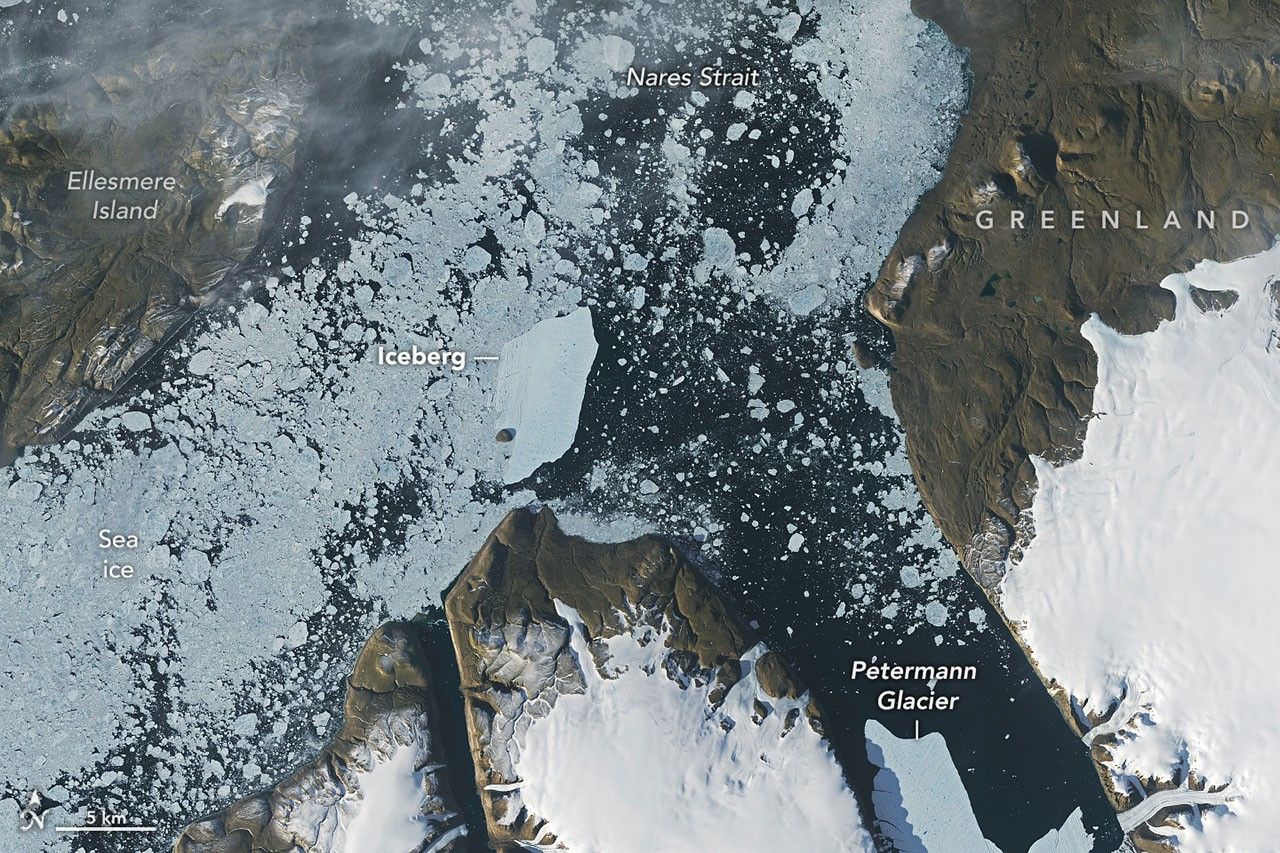
A large, flat-topped iceberg from northwest Greenland’s Petermann Glacier struck Joe Island shortly after leaving its fjord, but satellite images show that the ice formation remained intact after the encounter.
The iceberg calved on August 4, 2026, according to observations made with imagery from the European Space Agency’s Sentinel-1 mission. At the time, it covered just over 76 square kilometers—about 29 square miles—making it the largest iceberg to break from Petermann Glacier since 2012. NASA described the formation as roughly the size of St. Thomas in the U.S. Virgin Islands.
Glaciologists tracked the berg as it moved down Petermann Fjord at an average rate of about 3 kilometers per day. It reached the junction with Nares Strait, where it encountered Joe Island, a small rocky outcrop also known as Joe Ø.
Landsat 9 images captured on August 23 and 24 show the iceberg wedged against the island before pivoting away. Collisions with Joe Island have sometimes preceded the breakup of Petermann icebergs; the 2010 ice island, for example, split in two after striking the outcrop. Researchers were therefore watching closely as the 2026 iceberg made contact.
Adam Garbo, a doctoral student in glaciology at the University of Ottawa who has been studying the glacier with colleagues, said the team was impressed that the berg survived without additional fragmentation. NASA reported that the iceberg was less than 150 meters thick when it calved.
Wind and surface currents subsequently carried the ice out of the fjord and southwest through Nares Strait. It is expected to break into smaller pieces over time as tides, winds, currents, and melting weaken it, although the timing and course of that breakup remain uncertain.
Petermann Glacier is one of Greenland’s largest glaciers that terminates in the ocean. NASA noted that its icebergs and fragments can travel long distances, creating potential hazards for marine activity and infrastructure while releasing freshwater as they melt. Two additional large rifts remained on the glacier in late August, with researchers estimating that they could eventually produce ice islands of about 94 and 84 square kilometers.