Daily Weird News Report
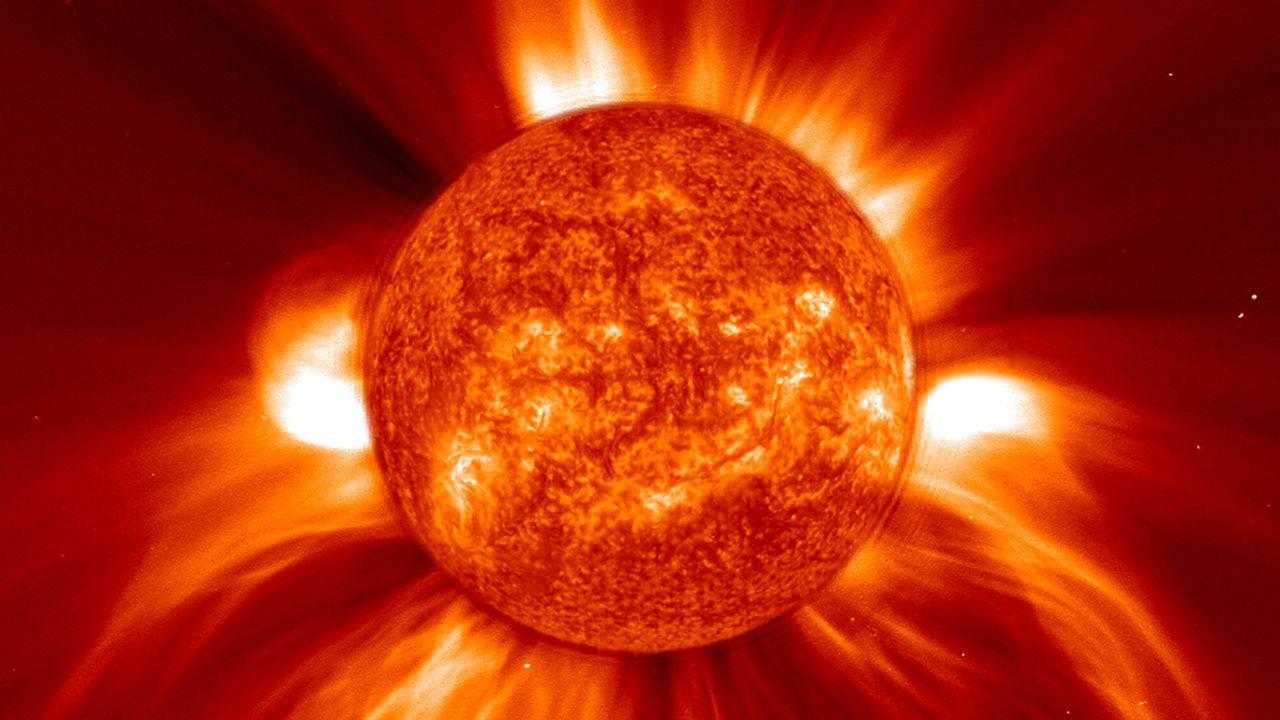
A coronal mass ejection that crossed the solar system in December 2024 has given researchers an unusually detailed look at how solar eruptions can differ in shape and speed.
According to reporting by Space.com, observations from 17 spacecraft showed that the CME had two asymmetric lobes. One moved quickly through the region between Earth and Mars, while a larger but slower lobe traveled farther west toward NASA’s STEREO-A spacecraft.
The eruption began at 00:48 Universal Time on Dec. 15, 2024. The Solar and Heliospheric Observatory, or SOHO, recorded the event near the Sun, but its view was dominated by the slower lobe. That meant the faster component aimed toward Earth was effectively hidden from the initial observation.
The CME was detected near Mercury on Dec. 16, at a distance of 0.35 astronomical units from the Sun. On Dec. 17, the faster component reached Earth, where several spacecraft observed it. Its average speed was about 840 kilometers per second. The slower lobe later reached STEREO-A on Dec. 18, having traveled at an average of about 534 kilometers per second and slowing to roughly 400 kilometers per second by the time it arrived.
Both portions decelerated as they pushed through the ordinary solar wind. The difference in their speeds indicated that the eruption was not moving as a single, unified front. NASA’s Europa Clipper detected the faster lobe farther out, at 1.19 astronomical units, while the MAVEN spacecraft observed the CME at Mars from Dec. 19 to Dec. 20.
Solar Orbiter did not detect the CME, despite being relatively close to the Earth-Sun line. Researchers used that non-detection, along with the other spacecraft measurements, to help constrain the CME’s shape.
The event was not powerful enough to produce significant auroras. However, Adrienn Luspay-Kuti of Johns Hopkins University Applied Physics Laboratory told Space.com that a CME missed by monitoring systems could reduce warning time for radiation hazards affecting astronauts beyond Earth’s protective magnetic field.
The cause of the eruption’s pronounced asymmetry remains unclear. Researchers are also investigating whether highly asymmetric CMEs are uncommon or are frequently overlooked because spacecraft are not usually positioned across such a wide area. The findings were published Aug. 19 in Science Advances.