
Daily Weird News Report
A proposed ship called the Blue Economy VITAL 100 MW Kraaken would combine three normally separate facilities: an offshore power plant, a desalination system and an AI-focused data center.
According to New Atlas, the concept comes from marine engineering firm InMar Technologies and energy systems developer OptiFuel Systems, working through their Optimal Transit partnership. The developers say the vessel would generate up to 40 MW of continuous electricity for shore use—enough to serve approximately 32,000 homes—and produce 30 million liters of fresh water each day, an amount they estimate could serve 150,000 people. Another 60 MW would be reserved for data-center computing.
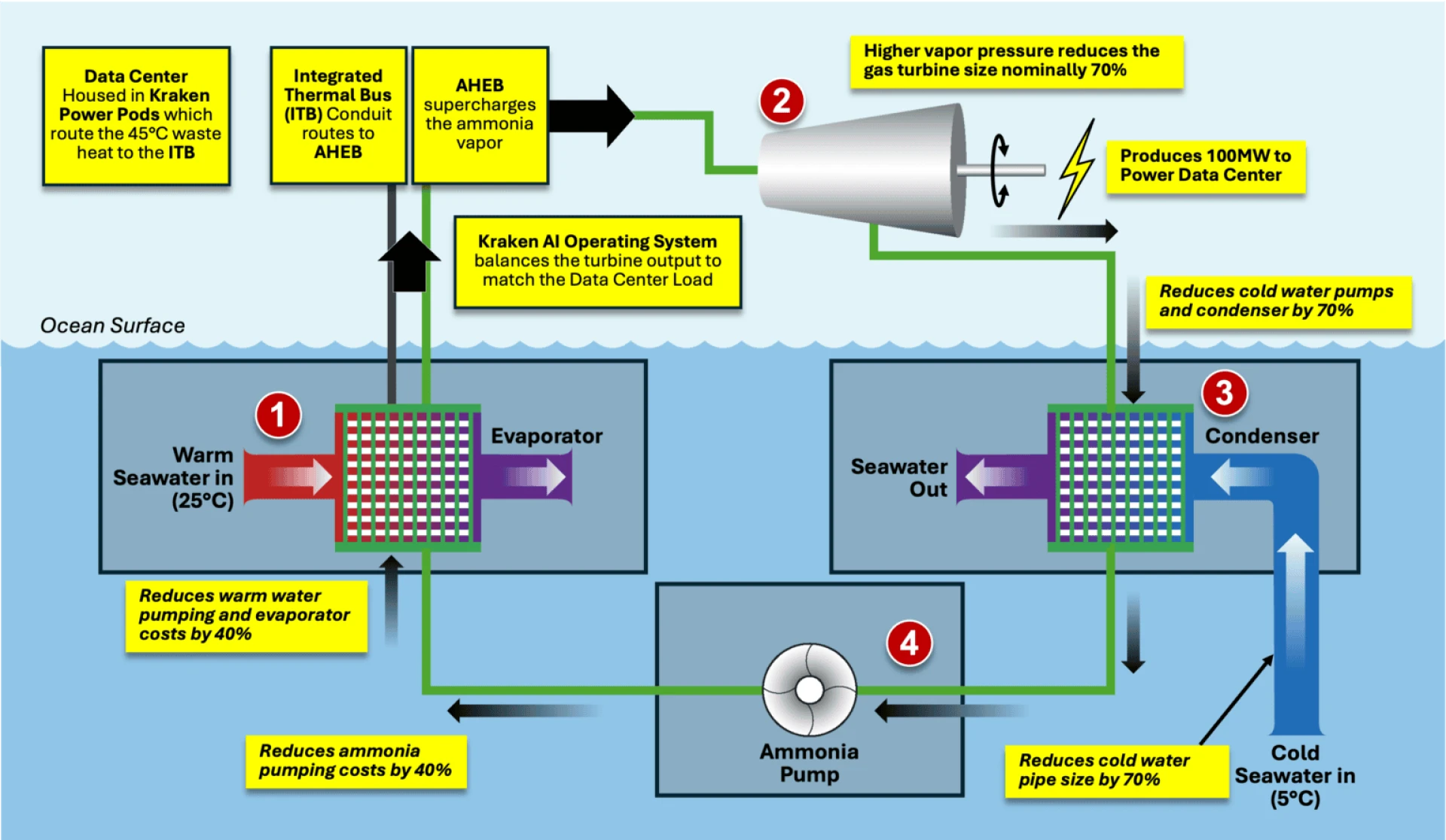
The proposed vessel would use Optimal Transit’s patented Digital Ocean Thermal engine, a modified ocean thermal energy conversion system. The process would draw on the temperature difference between warm surface seawater and cold water from deeper in the ocean. The company also plans to reuse heat from liquid-cooled computer servers to help drive the power-generation cycle.
Desalination would use vacuum-flash technology. Under low pressure, warm seawater can boil at a lower temperature, leaving salt behind; the resulting vapor would then be condensed using cold seawater.
Unlike a fixed offshore platform, Kraaken is designed as a ship. Its proposed Small Waterplane Area Twin Hull configuration would place much of the vessel’s buoyancy below the surface. Optimal Transit says the ship could disconnect from its moorings within hours before a major storm, move under its own propulsion and reconnect later. The platform would remain linked to land through a quick-disconnect umbilical carrying utilities and data.
The developers envision using the vessels near islands, underserved coastal areas, industrial sites and disaster zones. They estimate a single VITAL vessel would cost about $587 million and could be deployed in roughly three years, compared with six to 10 years for separately constructed land-based facilities.
However, the proposal remains at the planning stage. Optimal Transit has said Series A funding would support engineering drawings and digital-twin validation, while production would depend on a proposed Series B fundraising round in 2027.
New Atlas also noted unresolved technical questions, including how the vessel’s deep-water intake would disconnect and withstand movement during storms, how the system would maintain output outside waters with a strong temperature gradient, and how its published power figures account for pumping, desalination and onboard energy needs. The article said there is currently no 100-MW Kraaken operating offshore.