Daily Weird News Report
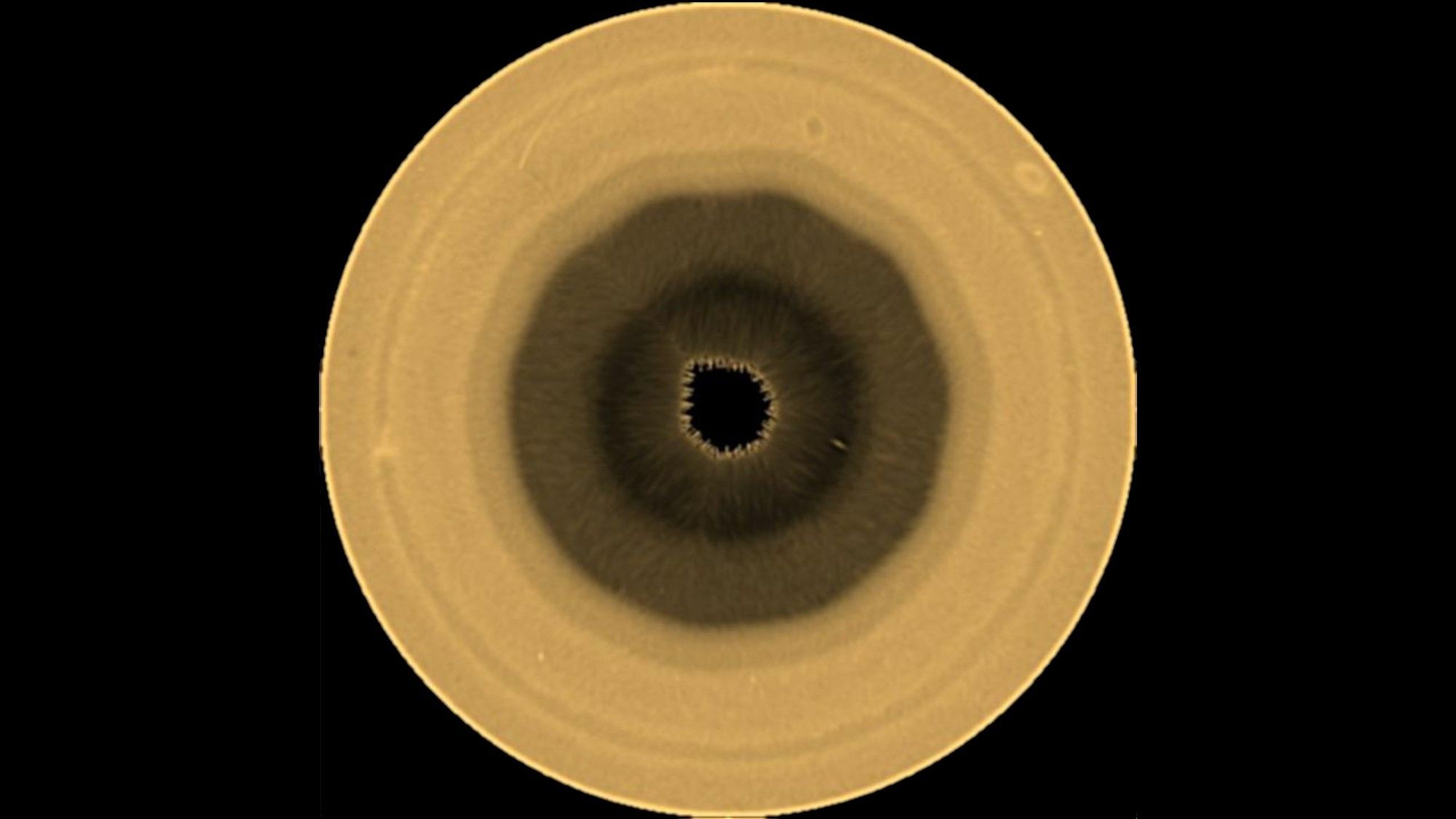
A giant cloud formation with 10 distinct sides has been identified around Saturn’s south pole, giving the planet a second large polygonal atmospheric pattern after the famous hexagon at its north pole.
The structure was found in images taken by NASA’s Hubble Space Telescope. Saturn’s southern hemisphere could not be viewed from Earth between 2012 and 2023 because of the planet’s axial tilt, and Hubble observations from 2023 provided the first evidence of the feature, according to Space.com.
Researchers estimate that the formation, described as a decagon, is about 104,250 miles (167,820 kilometers) across. Each side measures roughly 10,425 miles (16,782 kilometers). It also moves slowly, taking approximately 800 days to complete one rotation around Saturn.
The discovery surprised scientists who had spent years examining Saturn’s southern atmosphere for a counterpart to the north-polar hexagon. That six-sided cloud pattern, approximately 20,000 miles (32,000 kilometers) wide, was identified in data from NASA’s Voyager spacecraft in 1988.
Agustin Sanchez-Lavega, a planetary scientist at the University of the Basque Country and lead author of the study, told Space.com that the new observation indicates Saturn’s hexagon may not be a unique atmospheric feature.
The researchers used computer simulations of shallow-water currents to investigate how the decagon might have formed. Their simulations suggest that a meandering wave became trapped by a curving atmospheric jet near the pole. Earlier research had proposed a similar process for Saturn’s northern hexagon, where disturbances in an eastward-flowing jet may produce its six-sided shape.
Unlike the northern formation, whose sides and points have remained similarly dark for decades, the decagon’s features vary in darkness. The researchers said this may indicate that the southern structure is still changing.
They plan to study its clouds, hazes, winds and temperatures in greater detail. The scientists also want to determine whether the decagon will eventually become more stable or break apart as solar radiation increases toward a projected peak at its latitude around 2032.
The findings were published Sept. 2 in Science Advances, as reported by Space.com.