Daily Weird News Report
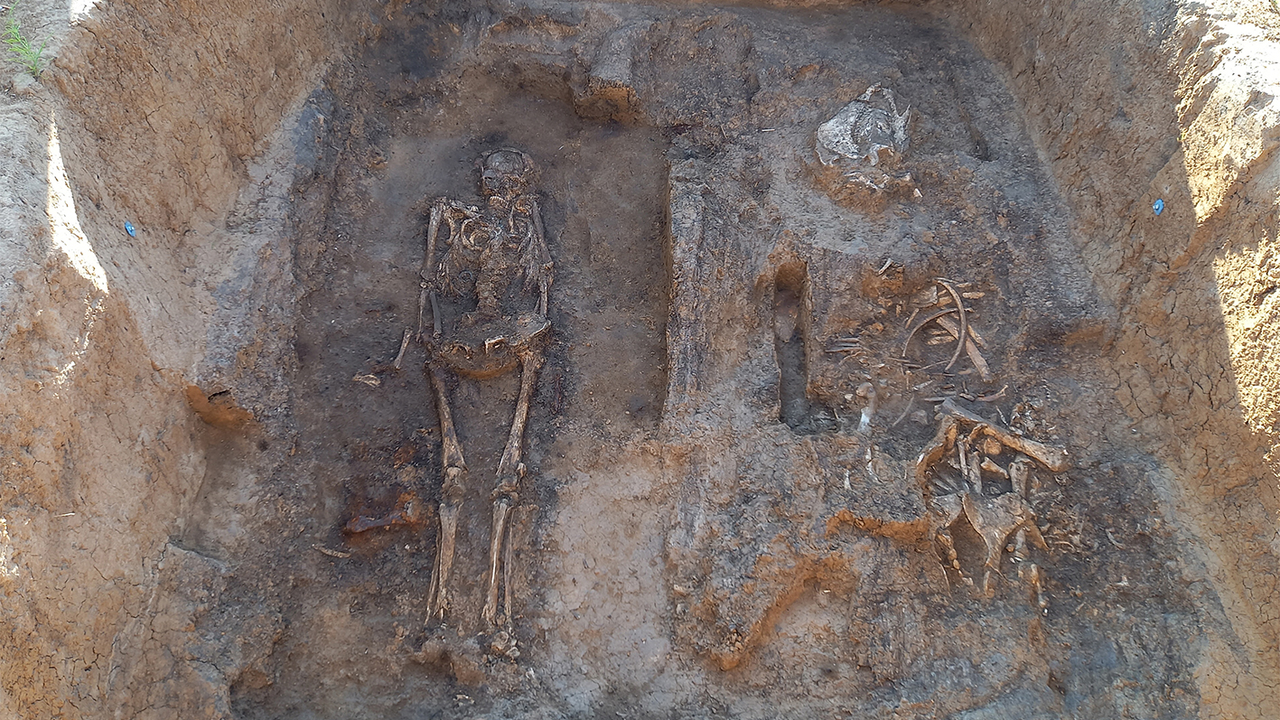
A wooden burial chamber discovered at the medieval cemetery of Gnezdilovo near Suzdal, Russia, has revealed the remains of an elite man buried alongside a horse and a dog. The tomb dates to the 10th century and is one of only a small number of medieval chamber burials identified in western Russia.
The discovery was made unexpectedly during summer excavations, according to the Institute of Archaeology of the Russian Academy of Sciences, whose statement was reported by Live Science. The chamber lay about 1 meter underground and measured approximately 3.1 by 2.7 meters. Its wooden roof had decayed and collapsed onto the burial.
Archaeologists determined that the man was between about 25 and 35 years old when he died. He had been buried with an iron knife, a battle ax, stirrups and other riding equipment. A silver, horseshoe-shaped brooch near his neck had likely secured his clothing. The collection of objects indicates that he held a high position in his community, according to the archaeological institute.
The burial custom was associated with Kievan Rus’, the medieval political realm that included Baltic, eastern Slavic and Norse populations in what is now western Russia. Underground wooden crypts containing numerous grave goods are thought to have been introduced from Scandinavia among the nobility of the 10th century.
Only about 80 other medieval chamber burials have been found across western Russia, and those excavated previously were located in urban centers. The Suzdal tomb therefore suggests that the settlement may have been an important site for the region’s elite, although the source describes this as an interpretation of the discovery rather than a direct identification of the man’s role.
Fifteen burials were excavated at Gnezdilovo during the summer. Most were simple graves dug into the soil, while others were covered by earthen mounds. Female burials included silver rings and necklaces decorated with rock-crystal beads, and male burials included weapons and horse-riding equipment.
/https://tf-cmsv2-smithsonianmag-media.s3.amazonaws.com/filer_public/d0/64/d064592c-d3fc-4ce4-a068-9252a84df55d/dr_steffen_g_scholz_credit_single_whitehead_torpedo_tube_locat-098ead67b3c8a8d78866627705003f89.jpeg)