
Daily Weird News Report
Astronomers studying an unusually powerful cosmic explosion say a black hole ripped apart a massive star—and that the violence may not have erased every part of it.
The event, formally identified as AT2024wpp and nicknamed “the Whippet,” was first detected by the Zwicky Transient Facility at California’s Palomar Observatory. Follow-up observations from the Liverpool Telescope and NASA’s Swift satellite showed a very blue object producing X-rays, characteristics associated with a rare class of events called luminous fast blue optical transients.
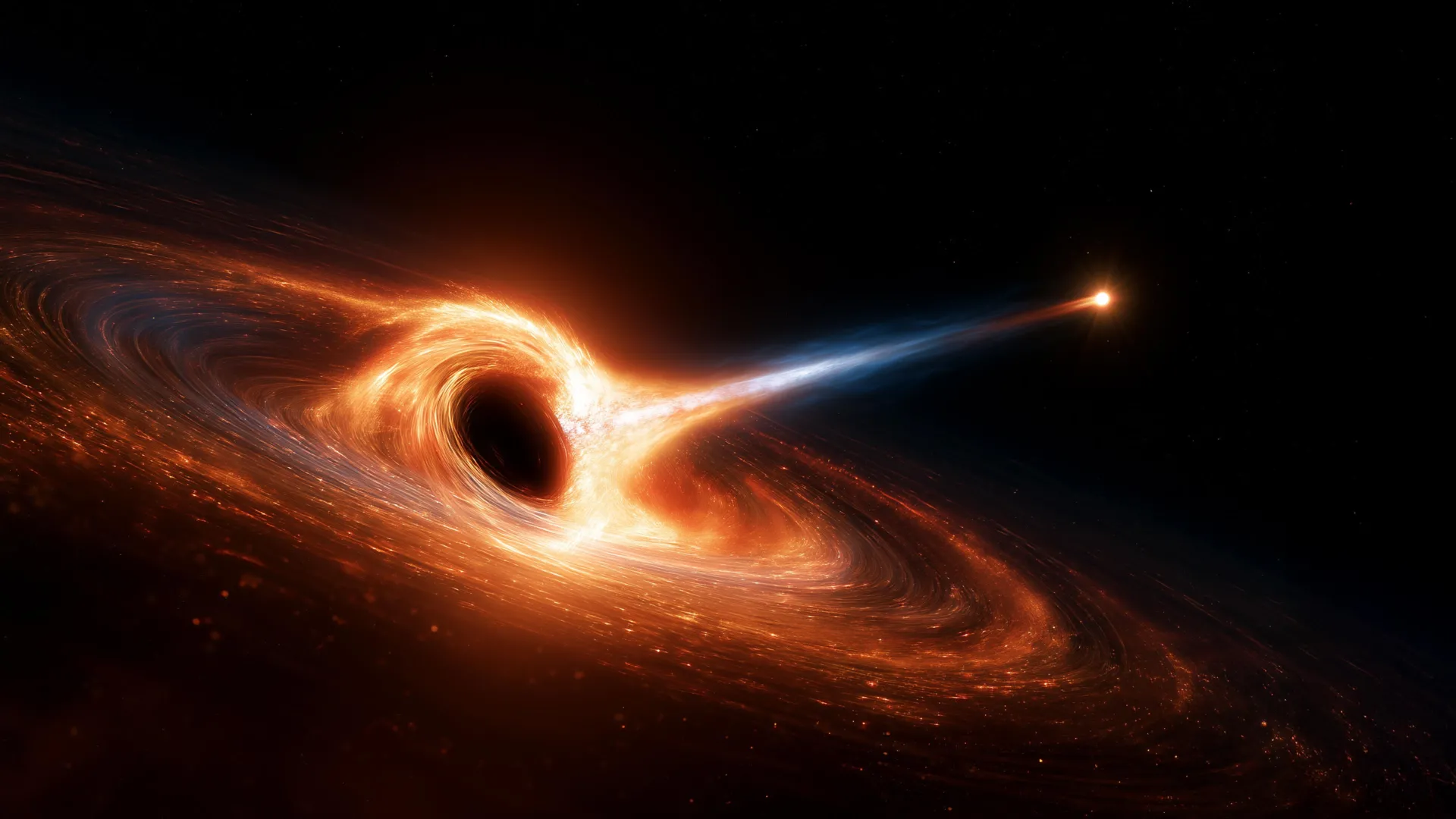
According to reporting from ScienceDaily, measurements indicated that the outburst released roughly 400 billion times the Sun’s energy for a short period, making it more powerful than known supernova explosions. Researchers concluded that the most likely explanation was a massive star being pulled apart and consumed by a black hole. The star’s material formed a disk around the black hole as it spiraled inward.
The encounter also produced a shock wave that moved through dense gas surrounding the system at about one-fifth the speed of light. After approximately six months, that shock appeared to weaken suddenly. Researchers believe it may have reached the outer edge of a bubble formed by gas expelled from the star before its destruction.
The more puzzling evidence appeared as the event faded. Early observations from the Keck, Magellan and Very Large Telescope facilities showed no identifiable chemical signatures. Later observations revealed faint hydrogen and helium signals.
The helium appeared to be moving toward Earth at more than 6,000 kilometers per second. That speed led the researchers to suggest that a tightly bound structure might have survived the initial disruption. One possibility is a stream of material from the star’s core, pulled loose by the black hole’s gravity. A more speculative explanation is that the signal came from a third object in the system, struck by the black hole’s powerful wind of particles and X-rays.
Those possibilities remain interpretations of the observations rather than confirmed explanations. The research, led by Liverpool John Moores University astrophysicist Daniel Perley and coauthored by Cornell astronomer Anna Ho, was published in the Monthly Notices of the Royal Astronomical Society.